Top 5 Desert cactus To Grow Indoors

Growing plants in your home can be a thrilling and satisfying experience. In fact, it is one of the best things that every plant enthusiast longs for in life. While there are many plants you can grow in your home, succulents will always stand out because they need minimal care to thrive. They also offer a wide range of exciting benefits such as improved concentration, productivity, and air purification.

So, what are the top five desert cactus to grow indoors? While there are more than 2500 cacti species, only a few stand out as great indoor plants. Opuntia, Christmas Cactus, Saguaro Cactus, Barrel Cactus, and the Old Lady Cactus are the most popular indoor cacti species.

These plants do well in average room temperatures and can still survive without exposure to lots of sunlight. Most of them are also flowering species and may surprise you with vibrant blooms, which is a bonus for plants that already thrill with their magnificent shapes and spiny textures.

In this post, we discuss these cacti species in detail and provide you with great insights into how to achieve better results.  Keep in mind that growing these succulents indoors is quite different from growing them outdoors. So, let us get started.

Saguaro Cactus

If you have ever visited the Sonoran Desert, you may never forget the astonishing sight of a 40-feet giant Saguaro cactus standing tall in the landscape. The Saguaro cactus (Carnegiea Gigantean) is an enormous and slow-growing plant that can live for up to 200 years.
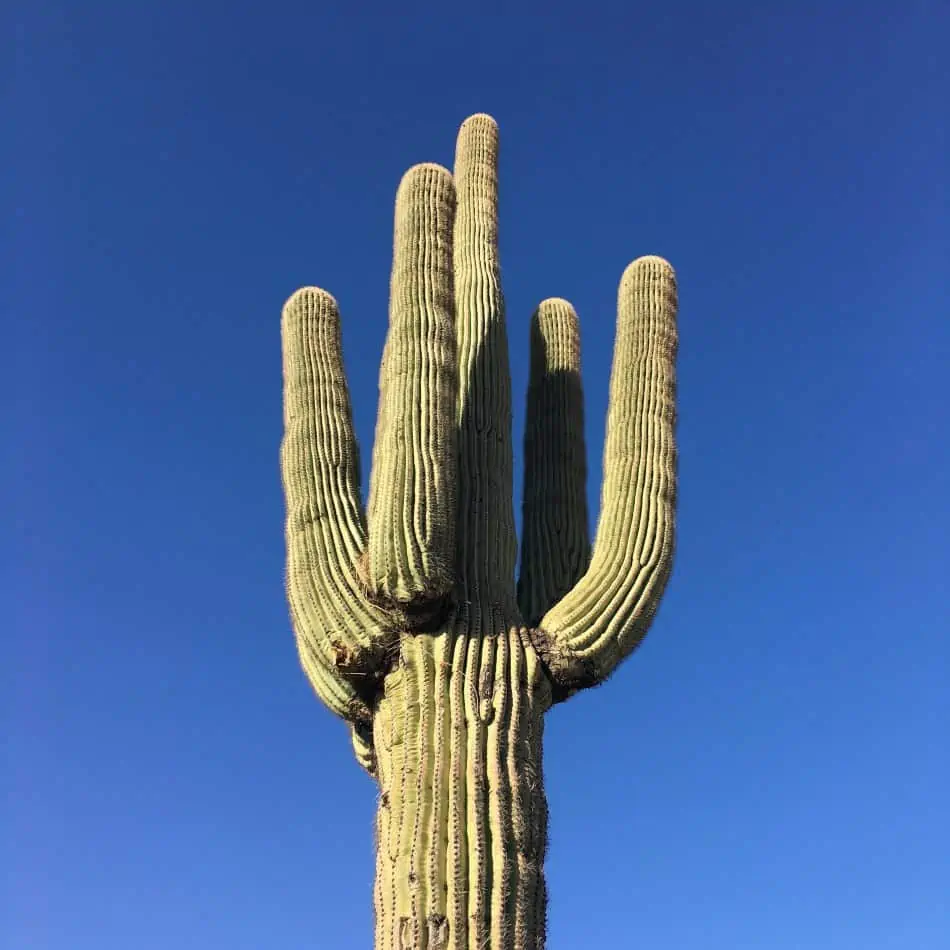
A mature Saguaro Cactus.
Saguaro Cactus requires well-drained soil and relatively hot environment to grow healthy.

Its scientific name translates to “gigantic candle” because of its large size. Saguaros are barrel-shaped with external water-storing pleats.

The plant can be used as a source of food for both humans and wild animals and provides a cavity-nesting for various birds. Saguaro plants also have peripheral stems known as arms.

An adult Saguaro can weigh up to six tons or more when filled with water and requires a relatively strong internal support skeleton.

Growing Saguaro Cactus Indoors

Saguaro cactus can only thrive in well-drained soil that doesn’t hold for too long.  The plant does well when it receives low levels of water and prolonged exposure to light.

Since it is used to growing in relatively hot conditions, this plant won’t survive freezing temperatures. Make sure you bring your containerized plants indoors as soon as temperatures fall below 60oF.

Water your plant at least once every 10 to 14 days and ensure the soil dries out completely between watering sessions. Check the soil to four inches deep with your fingers just to be sure that it is completely dry.

If you feel even the slightest moisture, wait for a few more days before watering. During winter, stop watering until temperatures start rising above 60oF.

Keep your plant in a brightly lit spot but maintain low humidity. Consider taking your Saguaro outdoors during spring and summer so that it can enjoy the sunlight. Consider keeping it out for several hours a day then bring it back indoors during the night.

Saguaro Cactus Blossoms

This plant is slow to develop and maybe 35 years old or even more before it starts flowering. It mostly blooms in May to June and produces creamy white flowers that are approximately three inches across. Saguaro flowers open up at night and close during the day.

Christmas Cactus

The Schlumbergera Bridgessii, commonly referred to as the Christmas Cactus, is one of the few spineless cacti species native to Brazilian tropical rainforests. The plant is characterized by its serrated green leaves and beautiful flowers.
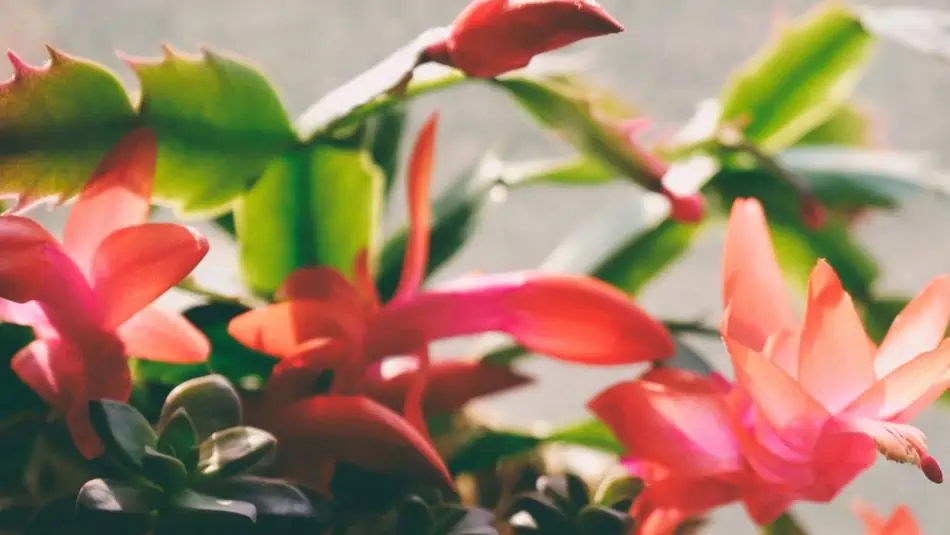
A flowering Christmas Cactus.
Christmas Cactus can grow healthy in low-light conditions with well-draining soil.

The Christmas Cactus does well indoors in relatively moderate home conditions. The secret to getting the best out of your holiday cactus is to avoid too much watering because it can lead to irreversible root rot.

The plant can adapt to low-light environments and does well in well-draining soil that doesn’t hold water for too long.  To achieve better results, make sure you use quality potting mix rich in humus and other vital nutrients.

Maintain your indoor temperature at 65oF and keep your soil evenly moist when the plant is flowering. During summer, move it away from the brightly lit spots into more shaded areas.

Christmas Cactus Bloom

The plant starts flowering in winter just around the Christmas period hence the name Christmas Cactus. To start blooming, the plant requires exposure to extended hours of darkness at least four weeks before the flowering season kicks in.

Therefore, it is crucial to relocate your Christmas Cactus to a dark spot in early October and keep it covered for at least 12 hours. This reminds the plant that the blooming season is around the corner, and it should start preparing to form flower buds.

When flower buds start to appear, introduce it to warmer temperatures, and resume regular watering regimen.  Fertilize your plant after the flowering season.

Old Lady Cactus

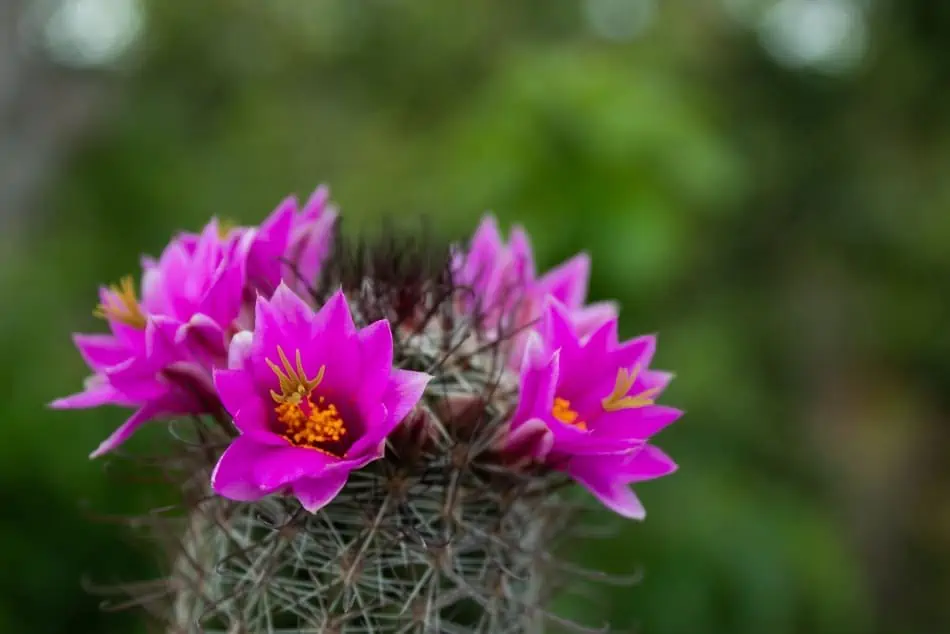
The Mammillaria Hahniana, also known as the Old Lady Cactus, is characterized by white hair that covers its entire surface. This cactus is from the Cactaceae family and is native to Guanajuato State of Mexico and the dry regions of Bolivia and Argentina.
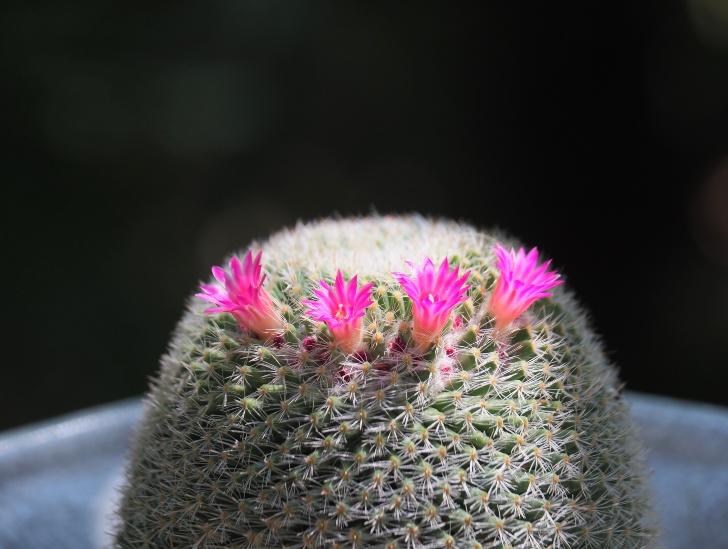
A flowering old lady cactus.
The Old Lady Cactus can still do well indoors if positioned in a room with moderate sunlight exposure.

The white hairs on its surface give the impression of an old lady’s white hair or old man’s beard. The hairs protect the plant from excessive heat and also hide the numerous amounts of yellow spines.

Growing the Old Lady Cactus Indoors

While it thrives well in an outdoor setting, the Old Lady Cactus can still do well indoors if positioned in a room with moderate sunlight exposure.

Plant the Old Lady Cactus in a fast-draining potting mix, preferably with added perlite or pumice for enhanced draining. If you are planting it in a pot, choose a container with plenty of drainage holes.

Although this plant is well-adapted to sustain excessive amounts of heat, do not be deceived because overexposure to direct sunlight can lead to severe and irreversible sunburns. Move it around in the course of the day if you are keeping it in a spot that is lit all day.

You should only water this cactus when the soil is completely dry because it only requires little water to thrive. Be careful not to overwater the plant because it can easily develop irreversible root rot.

During winter, cut back on watering because the plant is dormant and doesn’t require as much water as usual. You can stop watering altogether or only mist it once in a while.

Fertilize your Old Lady Cactus at least once in the summer with a high potassium fertilizer and consider repotting it at least once every year. Repotting should only be done during spring or early summer.

Opuntia Cactus

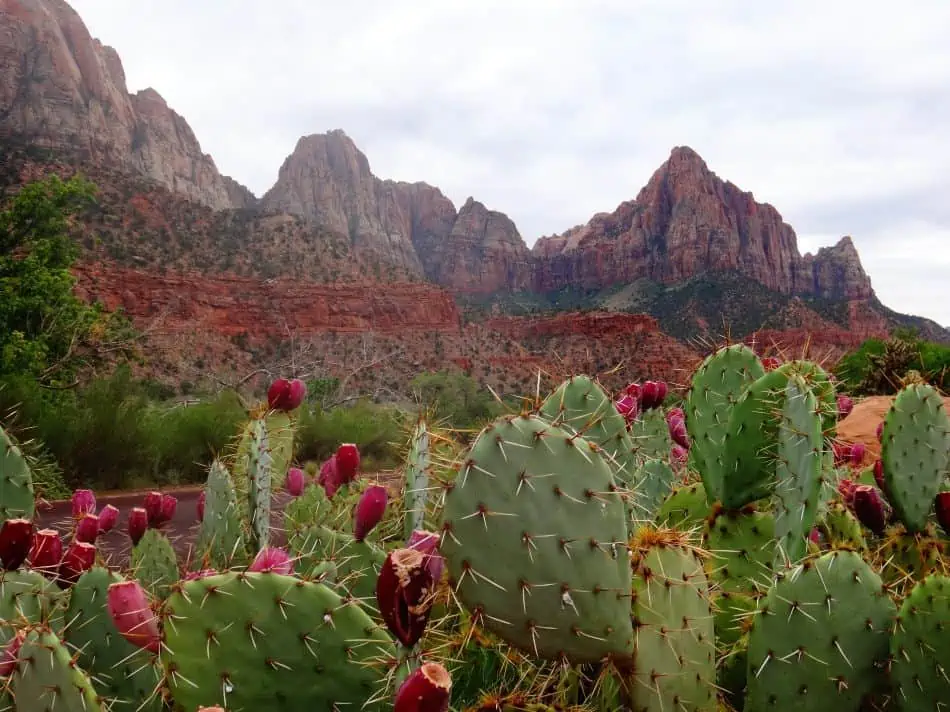
The prickly pear (Opuntia spp.) is one of the most popular plants in the Cactaceae family. It thrives in drought-prone areas, but it also does well indoors. The plant is characterized by flat and club-shaped pads containing many spines, hence the name prickly pear.
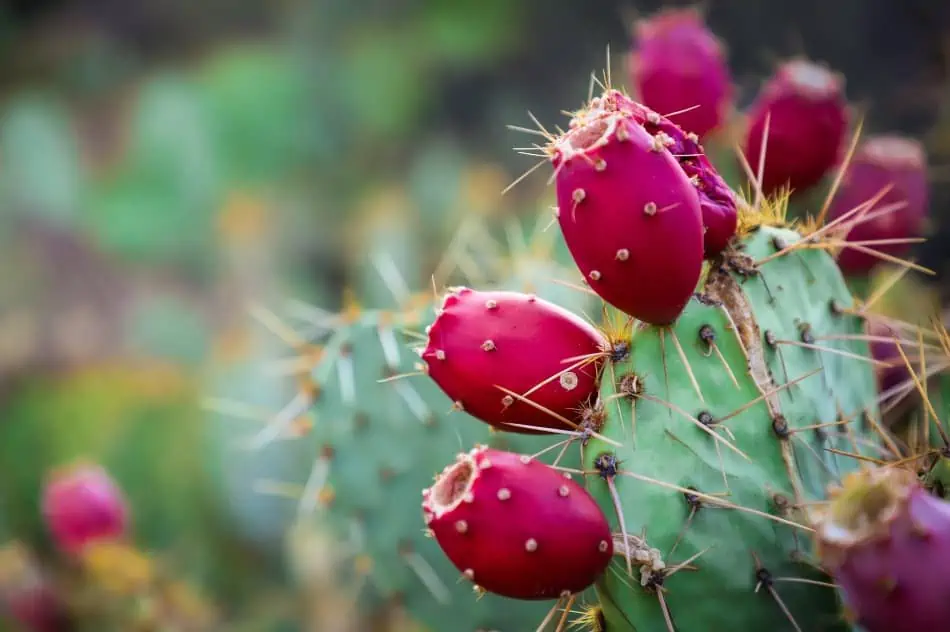
A prickly pear Cactus.
Prickly pear is a fruit-bearing cactus that can thrive in a well-lit place and fast-draining soil.

Most Opuntia cacti species are prized for their edible fruits commonly enjoyed as a refreshing snack in parts of Mexico and the United States. The plant blooms mid-summer, producing lovely yellow, purple and red flowers.

Growing Opuntia Cactus Indoors

As a desert cactus, the prickly pear requires maximum exposure to sunlight/artificial light to survive and thrive. Therefore, consider positioning it in a well-lit spot of your house that receives plenty of sunlight. A north-facing window works best if you live in the southern hemisphere.

However, these plants require little water to thrive. So, limit your watering to once every three or four weeks and only water when the soil is completely dry.  The most critical requirement for any plant in the Opuntia genus is a potting mix that drains fast.

Choose a potting mix that is well formulated to drain fast, and when watering your plant, simply moisten; don’t soak. If you are growing your Opuntia spp. in a pot, make sure it contains plenty of drainage holes.

Repot only when the plant outgrows its current pot and make sure you go for the right pot size. It shouldn’t be too small or too big.  Fertilize your plant twice every year to ensure healthy and quality blooms. Fertilization should be done in spring.

Barrel Cactus

This cactus is named after its barrel/circular shape. The plant is also nicknamed the “Mother-in-law-cushion” and is mostly found in Mexico and parts of Southwestern US.  In their natural habitat, these plants live in extremely hot areas and have adapted to direct sunlight.
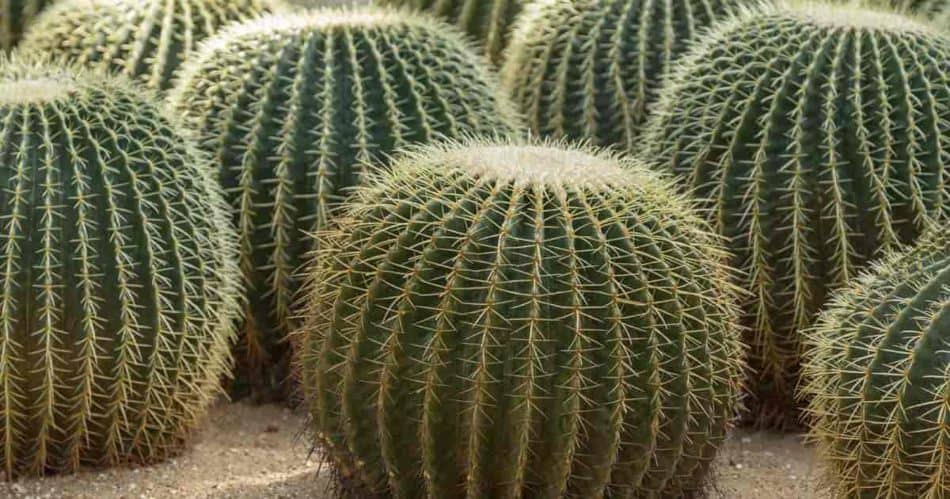
A golden barrel cactus.
Barrel cactus can grow in relatively low temperatures but cannot tolerate humidity.

They make perfect display plants when grown indoors since they are highly attractive.  As they grow, they tend to stretch out and assume a circular or oval shape. Just like other cacti plants, the secret to growing them indoors successfully is perfect drainage.

Growing Barrel Cactus Indoors

Barrel cactus does best in relatively sunny spots. Therefore, consider positioning it on a north-facing window. If your house doesn’t have a perfect place that receives plenty of sunlight, install artificial growth lights.

The plant can tolerate low temperatures of up to 50oF but does best without humidity.  As long as everything is kept constant, the plant should be fine in a regular household environment.

Make sure you use a well-draining potting mix and repot the plant as soon as the soil starts to break down. You can encourage drainage by adding sand or extra perlite to the soil or adding a few inches of small pebbles or gravel to the bottom of the container.

Feed your barrel cactus with a weak liquid fertilizer solution at least once during spring.  Water infrequently and ensure that the potting mix drains out completely during watering. Do not allow the plant to sit in water because the results can be catastrophic.

How Long Can a Cactus Survive Indoors?

Cactus plants are well-suited for indoor living since they require little maintenance. With proper care, cacti can survive indoors for several years and even decades.

Ensure you provide adequate light, the right soil mix, and enough water to help them thrive indoors. Also, remember not to overwater since too much water can lead to root rot.

Lastly, ensure you repot your cacti when needed and fertilize them twice a year. Typically, you should repot your indoor cacti every two or three years and fertilize them once in spring.

When repotting, pay close attention to the soil mix you use since this will determine how well your cacti survive indoors. A good quality potting mix that drains fast is essential for their healthy growth and survival.

Also, go for a pot slightly bigger than your existing one to provide enough space for the roots and top growth. Ideally, the new pot should be two to three inches larger than the previous one.

For instance, if the current pot is five inches in diameter, go for one that is seven to eight inches in diameter. This will give your cactus plenty of room to grow.

Can an Indoor Cactus Flower?

Yes, an indoor cactus can flower. While some cacti species may remain vegetative for years, others will produce flowers under the right conditions. 

Typically, these plants need plenty of light and a warm temperature to flower successfully indoors.

You must also remember to feed your cactus regularly during spring and summer to ensure healthy and quality blooms.

Consider using a balanced liquid fertilizer that is formulated for cacti and succulents. Use the solution at half strength and apply it every other month during the growing season.

How Often Should I Prune My Indoor Cactus?

It is normal for your indoor cactus to outgrow its pot and become bushy. As this happens, it will require regular pruning. Pruning helps encourage healthy growth and enhances the appearance of the plant.

To ensure vigorous growth, you should prune any overgrown parts of the cactus during springtime or summer. Use sharp pruning shears or scissors to avoid damage and cut the stems off at their base.

How Do I Treat Pests and Diseases On My Indoor Cactus?

Indoor cacti may be affected by pests and diseases, especially if they are overwatered or exposed to low temperatures. Common pest infestations include spider mites, mealybugs, aphids, and scale insects.

To treat these pests, you can use insecticidal soap or neem oil to eliminate them. Consider using a systemic insecticide formulated for cacti and succulents if the infestation is severe.

If your plant shows signs of fungal or bacterial diseases, consider discarding it because the diseases can quickly spread to other plants in your collection.

Summary

Cacti plants are a unique addition to your indoor plant collection. These plants are low-maintenance and easy to care for. Furthermore, they offer a wide range of benefits to you and your loved ones.  So, if you are ready to up your houseplant game, make sure you start with any of the cacti species mentioned above.
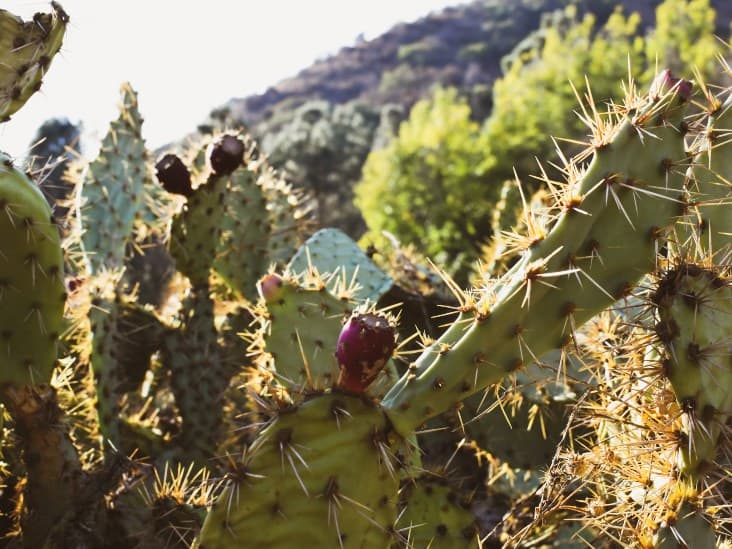
What kind of cactus live in the desert?

Cactus is one of the most noticeable plants in the world. While most cactus plants are adapted to grow in dry areas, not all are found in the desert. Notably, there are two primary classifications of cacti; desert and forest cactus. Desert cacti come in various types, ranging from the smallest, three-inch fish-hook cactus to the towering Saguaro cactus that grows up to 40 feet.

So, what kind of cactus live in the desert? There are literary thousands of cactus plants adapted for the desert. However, the most common types of cactus that live in the desert include the following:

  1. Saguaro
  2. Cardon
  3. Barrel Cactus
  4. Organ pipe cactus
  5. Prickly pear cactus
  6. Hedgehog Cactus
  7. Cholla Cactus
  8. Fishhook Cactus
  9. Pencil Cactus

This article will look into these and more of the desert cactus in terms of their features and adaptations. We take a look at their growth cycles, regions found, and their suitability as a homegrown or indoor plant.

1.     Saguaro

Saguaro cactus is one of the most recognizable cacti, thanks to its tree-like stature and growth. It can grow up to 40 feet tall with a lifespan of over 150 years. The cactus is native to Arizona’s Sonora Desert. Thanks to its long lifespan, Saguaro may grow its first sidearm at around 80 years of age, while some never do.

Saguaro is grown mainly from seed and rarely does so by cuttings, but when they do, its shape takes a totally different appearance. The cactus has an extended root network that may go up to 100 feet. Its long tap roots run up to 3 feet deep. The spines are notably sharp and may grow up to 1mm per day.

A Saguaro cactus exposed to sunlight.
Saguaro can grow up to 40 feet in height with spines that lengthen by 1mm per day.

This gentle Mexican giant produces white waxy flowers that appear from April through June.  The flowers bloom well after sunset and would close in the afternoons.

Saguaro cactus can be grown indoors as long as they are placed in a brightly lit room with a possibility of being moved outside regularly.

2.     Cardon

Cardon, also known as the elephant cactus, is one of the biggest cacti found in the desert. It is native to northwest Mexico and found in states like Sonora and Baja California Sur. It grows up to 70 ft tall and can weigh up to twenty-five tons.

Fruits from Cardon cactus were a vital food element for Sanora’s Seri people. The cactus has a special relationship with fungal and bacterial colonies on its roots. This allows it to grow even on bare rock with no soil support whatsoever. This is all thanks to the bacteria that helps fix nitrogen from the air, thus breaking down the rock for nutrients.

Cardon resembles Saguaro in shape and growth, but it is more heavily branched with its branches appearing just at the base of the step. This cactus produces large, nocturnal, white flowers that occur along the plant’s ribs rather than only at the stems’ apices.

The Cardon cactus can be grown indoors but needs enough sun and heat as it is adapted for the deserts.

3.     Barrel Cactus

Barrel cactus is one of the most resistant desert cacti and is native to the South and North American deserts. The largest specimens of the cactus are found in southern California’s Mojave Desert. At maturity, some species of the cactus can reach over 3 feet tall.

The cactus stands out with its numerous, pronounces ribs. It also features long spines that may range in color from red to yellow to tan, depending on the plant’s species and age. After several years of growth, flowers will be seen at the top of the plant. Its flowers are mostly orange or bright yellow, but there are varieties with red and pink colors. It has a lifespan of about 100 years.

A barrel  cactus.
Barrel cactus can live anywhere between 50 to 100 years and can grow up to 10 feet tall.

Barrel cactus produces a small pineapple-shaped fruit after flowering. This fruit can stay on the plant for a full year if left untouched. However, the fruit is not edible as it is mostly bitter and fairly dry.

4.     Organ Pipe Cactus

The organ pipe cactus derives its name from its resemblance to a pipe organ. Locally referred to as ‘pitaya dulce,’ organ pipe cactus is native to the United States and Mexico.  It is mostly found in the regions’ rocky deserts.

 The organ pipe cactus has its stems growing from a single short truck. It develops several stems about 6 inches thick. Depending on the region, the plant can grow to a maximum height of 16 o 26 feet. A fully mature plant of the cactus can extend to a width of about 12 feet, with each step featuring 12 to 19 inch, dark brown or black ribs.

The plant produces funnel-shaped white flowers that bloom at night and close at dawn. This makes bats its primary pollinators. It also produces an edible fruit the size and shape of a tennis ball.

The organ pipe cactus can be grown indoors but needs exposure to full sun and irrigation at least once a day during the hot, dry weather.

5.     Prickly Pear

The prickly pear, also known as opuntia or nopal, is one of the flat-stemmed spiny cacti native to the Western Hemisphere. Most of its species are homegrown and are an essential source of food for most inhabitants of tropical and subtropical countries. Its common culinary species, the Indian fig opuntia, may grow 16 to 23 feet tall with a trunk diameter of about 3 feet.

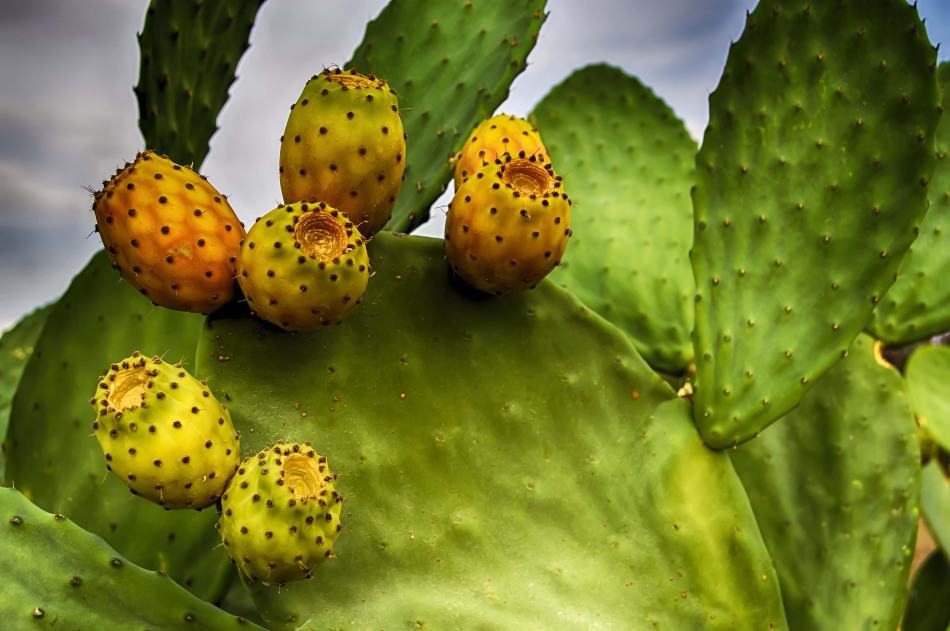
A fruit bearing prickly pear cactus
Prickly Pear is a fruit-bearing cactus that grows up to 23 feet tall.

The plant produces large, solitary, axillary, and bisexual flowers that later lead to a berry-like yellow, white or reddish-purple fruit with arillate seeds. This desert plant can be grown at home with warmer climates preferred. Prickly pear is widely known for its edible fruits and use as a forage crop. Its hard seeds come in handy in the production of oil.

Cutting and propagation of the prickly pear are possible through its stems. While its fruits have mostly been a source of food for the natives, research also shows some cactus varieties have medicinal values. This is all thanks to their pectin and fiber, which may help lower blood pressure by decreasing sugar absorption in the intestines and stomach.

6.     Hedgehog Cactus

Hedgehog cactus is a low-growing desert cactus found mainly in the southwestern United  States. Otherwise referred to as Engelmann’s hedgehog cactus after George Englemann, a renowned botanist and physician, this cacti variety earned its name thanks to its resemblance to hedgehogs.

Hedgehog cactus grows lowly and produces several clumps ranging from about 40 to 50, 12-inch green stems in each clump. Depending on the number of clumps, the plant can grow 2 to 3 feet wide. The cylindrical stems feature between eleven and fourteen ribs with solidly covered spines.

A flowering hedgehog cactus.
Hedgehog Cactus comprises 40-50 stems that grow about 12-inch tall and produces colorful flowers and fruits.

This desert succulent produces colorful flowers that eventually lead to some edible, spherical fruits. At its initial stages, the fruits are fully covered with spines, but these fall off with time as the fruit ripens.

Propagation of hedgehog cactus can be done through offset cuttings or seeds. For better results growing this cacti variety at home, it is recommended to sow in summer or spring.

7.     Cholla Cactus

The cholla cactus is a shrubby desert succulent native to North America.  It grows in joints of various lengths. The joints feature some formidable-looking spines and brightly colored. These spines generally act as reduced leaves and feature an external papery sheath.

The cholla cactus can stick or hold on to anything it gets in contact with, thanks to its tiny curved hooks on the spines. The cholla cactus comes in various types that include:

Slender Stemmed Chollas – Otherwise known as diamond cholla, this cholla variety feature slender, blue-green stems the produce long, white spines.  These are native to the Sonora and Mojave Desert.

Tree-like Chollas – Otherwise known as chain fruit cholla, this variety features a strong central stout trunk when fully mature. It also has its flowers blooming from its older fruits. The plant can be propagated from loose joints or fruits.

A cholla cactus flowering.
These spines generally act as reduced leaves and feature an external papery sheath.

Shrubby Chollas – Otherwise known as Staghorn cholla, this cholla variety stands out with its branching habits that mimic deer horns. During winter, its stems turn purplish while its flowers range from yellow to greenish to red.

Despite being a desert succulent, the cholla cactus can be grown in home gardens and as barrier plants.

8.     Fishhook Cactus

Fish-hook cactus is a general name that applies to any hook-spined species of the Echinomstus, general Mammillaria, and Scierocactus. It is one of the smallest of the desert cacti, growing to about 7 inches high.

This cactus got its name from its spines that resemble fishing hooks. In fact, some species of this desert cacti feature notably strong spines that could be used as actual fishing hooks by the natives throughout the Americas.

Each of its cluster spines features 3 or 4 black, hooked central spines and a couple of white radial ones.  The fish-hook cactus produces brightly colored, pink, or white flowers measuring about 1.4 inches. This eventually leads to a fleshy, shiny, red fruit with black seeds.

9.     Pencil Cactus

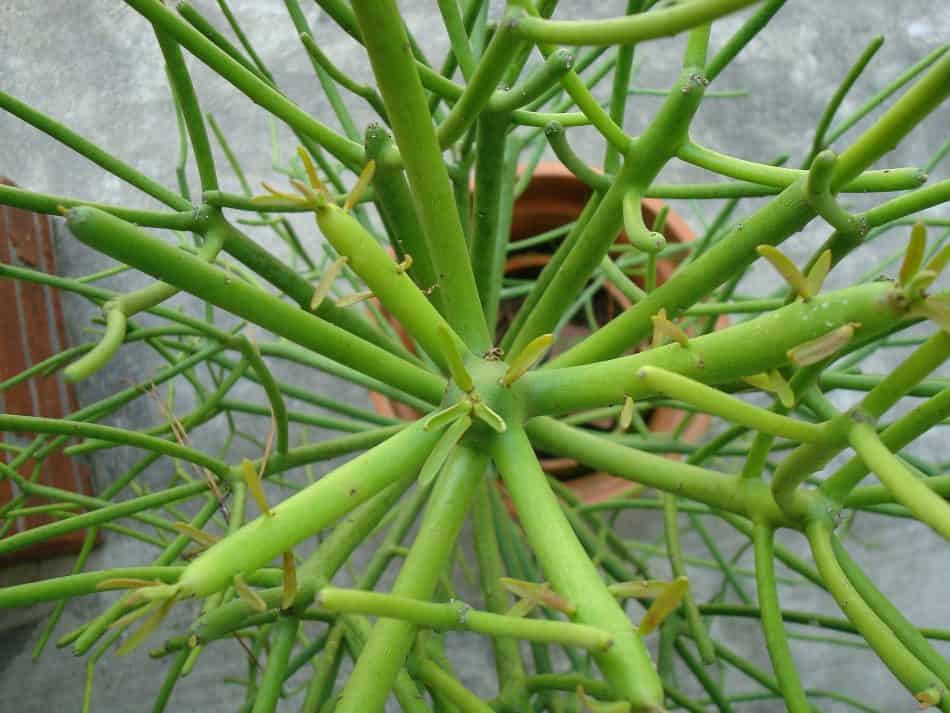
The pencil cactus may not be a real cactus per se but rather falls in the Euphorbia family. It got its name from its tiny stems that resemble a pencil in size and shape. When injured, the plant produces some cloudy, milky sap, thus earning the nickname ‘milk bush’. This desert succulent is native to India and Africa.

A top view of a pencil cactus,
Pencil Cactus is a low-maintenance plant that comprises thin pencil-like stems.

The pencil cactus can grow to about 30 feet tall. It is a leafless plant, but some tiny leaves would usually appear at the tip of new branches. These eventually fall off as the branch matures. As such, it uses its pencil-sized branches for photosynthesis.

This desert plant can be grown in home gardens with minimum watering and gritty soil.

How are cactus plants adapted to their environment?

Apart from their unique appearance, cacti also have another outstanding feature that sets them apart from most conventional plants. Its ability to adapt thrive in the harshest of environments is remarkable. The cactus is adapted to dry areas thanks to a number of features and characteristics. Here are some of these features:

Shallow root systems

Water is hard to come by in the deserts.  Faced with this reality, cacti adapt through its extensive shallow root system. The roots spread over a larger area but just below the surface to tap on the little rainwater that comes by once in a while. Larger varieties of cacti, like the giant Saguaro, would, however, have one deep taproot to help anchor the frame above by keeping a strong base.

During the rainy season, most cacti develop temporary root hairs to help harness the little water and prevent loss of the same.

Leafless

Apart from a few species, Cacti are generally leafless. This is an adaptive strategy that helps minimize water loss during photosynthesis. Desert cacti have transferred photosynthesis from the leaves to its stem to help reduce moisture loss that would naturally happen through the stomata. It complements this by adopting CAM photosynthesis, a process where the plant’s stomata only open when temperatures are cooler, preferably at night.

Succulence

Cactus stems are specially designed to store a large amount of water, thanks to its succulence. A cactus’ cortical layer is specially adapted to act as a water reservoir through its thin but flexible water-holding cells. This water would then be released in bits when it matters most, preferably during the dry seasons.

Temperature resistance

For plants growing in desert environments, one of their worst enemies is the sun. The scorching heat from the sun can be unforgiving for any living organism, and this is no different for cactus. However, cacti have adapted to this thanks to the accordion effect.

The accordion effect is a process whereby cactus ribs and tubercles expand without bursting and would later retract as the water is used up. This helps minimize the surface area facing direct sunlight.

A cactus exposed to sunlight.
Excess direct sunlight can damage the plants, but cacti are more resistant to head due to the accordion effect.

Slow Metabolism

Leaves help catalyze photosynthesis and subsequently plant growth. For desert cacti, however, less green tissue means a slower metabolism. This makes them slow growers. On the flip side, this is a positive adaptation for desert environments. It helps them conserve energy that would otherwise be used in developing additional foliage. Instead, cacti focus on maintaining existing structures that keep them alive.

The slow metabolism also helps cacti attain longer lifespans. Some cacti species have been documented to live for up to 200 years. The longer they live, the better their chances of reproduction.

Protective Spines

The majority of desert cacti feature spines that come in various shapes and colors.  These are not meant for beauty but a protective feature that helps the plant ward off predators.

Considering cacti would thrive and remain green even during drought, some animals would be tempted to tap into their succulent stems. The spines help deter these efforts, thus increasing their chances of survival.

Can Desert Cactus be grown at home?

While cacti are suitably adapted for the deserts, most of them can easily thrive in home environments as long as favorable conditions are met. This said, you can easily grow desert cacti, either in your garden, on the patio, or indoors.

However, harvesting desert cacti in its natural habitat is illegal in most states, and it is essential to get the requisite licenses and approvals before embarking on the same.

How to care for desert cacti at home

Despite their adaptation to the desert environments, cacti need some good care to thrive better.  For instance, frequent watering helps cactus flower much easily and with brighter blooms.  However, take caution not to overdo processes like watering; once or twice a month will do.

Good compost also matters for desert cacti. Ensure you have a well-drained compost to avoid too much dampness. The compost would also look much better with a top layer of pebbles or gravel for a naturally polished look. This will also add to the stability of the plant as it grows taller.

Pot size also matters when growing cacti indoors; they thrive and flower better when grown in small pots.  Being an outdoor plant, cactus needs adequate sunlight too.  When grown indoors, always ensure they are positioned in a brightly lit area. In addition, good loamy soil with neutral soil pH will work best.

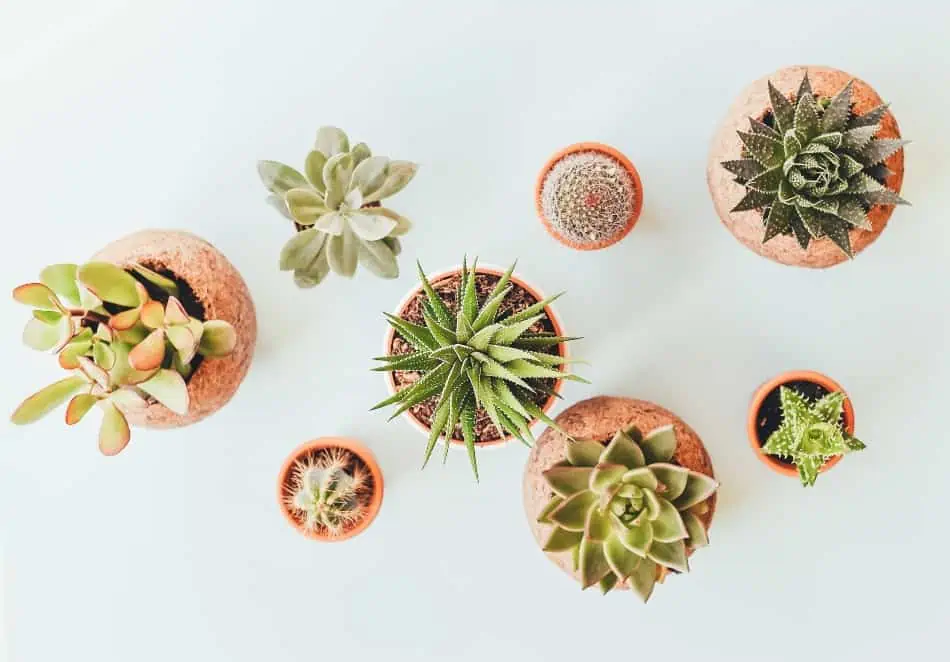
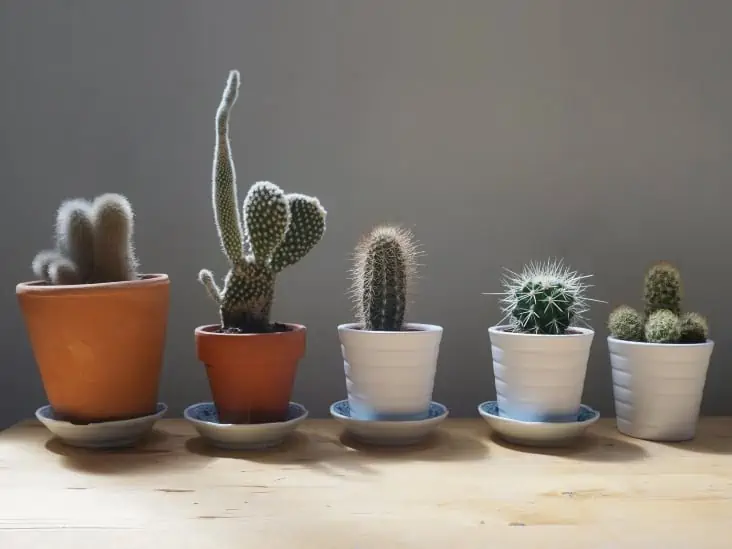
A top view of different kinds of succulent and cactus plants oon a pot.
To grow healthy cacti at home, you should select well-drained soil and appropriate pot size for a specific plant.

Desert cactus has a fragile and intricate web of life. They come in the weirdest shapes and sizes, but all these are meant to help cushion the succulent from the desert’s unforgiving conditions. There are literally thousands of desert cacti species. While some are extinct, others are on the verge of getting wiped out, thanks to illegal human activities and natural disasters. 

As much as most of these desert cacti can be grown at home, others are not recommendable due to their toxicity, size and government restrictions. Before getting a desert cactus for our home garden, ensure you liaise with the relevant local administration for proper approval and licensing. Your choice for a desert cactus type will highly depend on its availability within your area, its purpose at home, and your personal preference.

How to Grow a San Pedro Cactus (Echinopsis Pachanoi)

Scientifically known as the “Echinopsis Pachanoi”, a San Pedro cactus can be a great houseplant choice to liven up any space. The steps to growing it and caring for it are no more unique than the steps needed for any other plant. But following these steps will ensure that your San Pedro cactus is flourishing and healthy. 

The steps to growing a San Pedro cactus include choosing the right cactus soil mix from any local plant store and giving it the proper amount of water and sunshine. You can also propagate it to other pots or patches of land. 

While those are the basic steps to planting a San Pedro cactus, the following is a more detailed description of all the previous steps and a guide on how to maintain your San Pedro cactus. There is also a brief introduction into what you should know about the San Pedro cactus before you purchase one. 

Steps to Growing a San Pedro Cactus 

The first step to growing a San Pedro Cactus is to make sure you have the right tools. The gardening tools you’ll need include: 

  • Water 
  • Cactus potting mix 
  • A 5- or 6-inch plant pot 
  • Potting soil 
  • Trowel 
  • Gardening gloves 
  • Fertilizer 

You can get all the above gardening tools from your local gardening tools and plants supplier. 

Choosing the Right Soil and Putting it in the Pot 

Once you have your tools, the first step is to fill the pot with the right soil. The right soil for a San Pedro cactus is, first and foremost, porous that will drain easily. This is to make sure that the water won’t rot the base of the cactus. San Pedro cacti also like a dry soil since they naturally grow in drier climates. You can make a soil more porous by adding materials like: 

  • Pearlite 
  • Sand 
  • Gravel 
  • Pumice 

Adding these to an existing soil mix will help maintain a suitable soil for your cactus. You can ask any expert at your gardening supply store for a quality beginning cactus soil mix or make your own. 

Transporting the Cactus from Nursery Pot to Permanent Pot 

Once you have your soil, fill the pot you’ve chosen about halfway with it, evening it out with your trowel. You can also add a 1/4- to 1/2-inch layer of any of the prior draining materials on the bottom to assist with drainage. 

  • Dig a small hole in the center of your soil with your finger, about two to three inches in diameter. 
  • Put on gardening gloves and carefully remove the cactus from its nursery pot, placing it directly into the hole you just made. 
  • Tightly tuck and pack soil around the cactus until the roots are fully covered. 
  • Water the cactus until the soil is damp, but not sopping wet. 
A person repotting the plant.
To transport the cactus to its permanent pot, fill it halfway with soil and draining materials accordingly.

When your cactus is firmly rooted, usually after about four to six weeks, you can add fertilizer to give it some extra nutrients. Only do this once it’s rooted, not before then. When a cactus grows roots, it’s ready to take in food.

Watering and Fertilizing Your San Pedro Cactus 

It’s recommended that you water your cactus once a week. If you’re growing your cactus from a seed, it’s recommended you water it twice a week until you start to see something growing out of the soil. One method of doing is to fill a sink large enough to fit your cactus with about two inches of water. 

Let the water seep into the cactus’s soil through the holes in the plant pot and take it out once the soil is fairly damp. You can also water it the traditional way with a watering can, but water it in sections throughout the week to avoid the soil getting soggy. 

Stop watering it when it gets around to the colder months. The cactus will go dormant between the months of October and April and watering it during this time will just make it rot faster. Overwatering can give bacteria an ideal environment to grow and infect the cactus. Cold temperatures can also prevent a San Pedro cactus from being watered properly. It can keep the water from evaporating, making the soil soggy and leading to a rotting cactus .

A person watering the plant.
Typically, a San Pedro cactus needs to be watered once a week.

Fertilizer is what feeds your cactus and gives it the nutrients that water alone can’t give. For cacti, liquid fertilizers are available for you to pour into your plant pot that will help the cactus flourish. Seedlings will need a slightly diluted version of the fertilizer, but adult cacti can be given an undiluted fertilizer.  

Giving Your Cactus Plenty of Sun 

Since the San Pedro cactus is originally a desert plant, it needs plenty of pure sunshine. Start by slowly introducing your cactus to sunlight, especially if it’s a seedling. Seedlings tend to burn in direct sunlight and end up dying. 

To introduce your cactus to sunlight, place them in a position where they’ll get some shade along with the sunshine to lessen the harshness of the sun. You can also start by only introducing the cactus to morning or evening sunlight, which are less intense than the sunlight at midday. You can also put your San Pedro cactus underneath the shade of your larger plants if you have any. 

A cactus exposed to sunlight.
San Pedro cactus loves sunshine, so make sure the plant gets enough sunlight to obtain the necessary nutrients.

If you’re growing your cactus indoors, they will need more sunlight once they get accustomed to it. Placing them in a spot where there’s often sunlight, such as a window or near a porch, will help them get the nutrients they need from the sun. If your cactus is outside in the direct sunlight, make sure to keep it consistently watered since it can dry out faster. 

Propagating Your San Pedro Cactus 

Propagating your cactus means carefully cutting it up and planting those pieces as separate plants. It’s a great way to save money from buying more plants and can help your garden grow faster and be healthier. To start propagating your cactus, you’ll need: 

  • A knife 
  • A plant pot 
  • Soil 
  • A piece of cardboard or a towel 

When you have all your materials: 

  • Clean your knife with an alcohol-based sanitizer and make sure it’s dry before you cut. This will prevent the risk of spreading infections to your cacti. 
  • Decide on a piece of cactus that is healthy and flourishing, and carefully cut it to the length you desire. 
  • Once you have your cactus piece, lay it out in the sun for a day or two. Cover it with a piece of cardboard or a towel if it’s in direct sunlight so it won’t get burned. This will dry it out and make it easier for the cactus to take root in its new pot. 
A person propagating plants.
To propagate your San Pedro cactus, you can obtain healthy cuttings and plant them separately.

As the cactus dries, they can start to develop some color. These spots of color are called calluses and usually range from white to brown to black. This is a good sign, as it signifies the cactus piece is ready to be planted. As long as they calluses aren’t a moldy green or blue color, they are ready to be potted. 

The process for this step is essentially the same as potting the original cactus. The only difference is that, since the cacti are smaller, use pots that are also smaller. A diameter of about one to one and a half inches is recommended. 

Place it in a shady spot and don’t water it for about two weeks. This will allow the roots to start growing and the cactus to get used to its new home. Once it’s rooted, you can start watering it and giving it fertilizer as you would with the original cactus. 

Maintaining Your San Pedro Cactus 

Being a natural plant, the San Pedro cactus won’t always grow in a neat and perfect way. When your cactus starts looking unruly, that’s when you need to start cutting and grooming it. Keeping it looking neat and clean will help keep it healthier in the long run, as the less wild growths it has, the less chance for infection. 

To clip a cactus, all you need is a solid, good quality pair of garden shears that you can get at your local garden supply store. When cutting the cactus, make sure to cut twelve inches or more since these types of plants tend to grow much faster than on average. 

San pedro cactus on a pot exposed to sunlight.
Keeping it looking neat and clean will help keep it healthier in the long run.

Another thing you should do while maintaining your cactus is to make sure that the soil is properly draining the water. You can make sure of this by gently touching the soil. If it feels too soggy or more wet than solid, the soil isn’t draining properly. You can fix this problem by replacing the soil and putting a small layer of the porous materials listed above. 
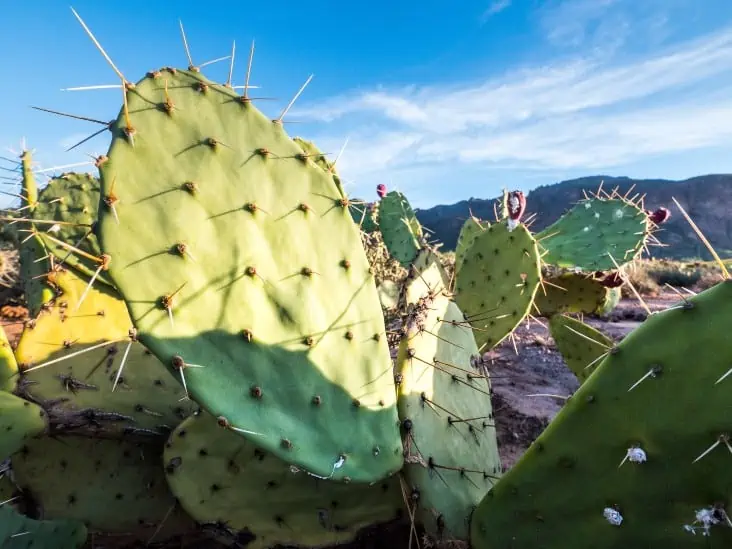
The final thing to make sure of when maintaining your cactus is that the soil and the cactus are free of infections and pests. To do this, you can lightly spray your cactus with a pesticide killer to get rid of any possible intruders. But do this sparingly, only about once every two months, as too much of the pesticide killer can end up killing the cactus. You can also add a little bit of sulfur to the soil, and it will act as a natural pesticide. 

Things to Know About the San Pedro Cactus 

Now that you know how to plant and take care of a San Pedro cactus, there are some things you should know before you decide to purchase it or include it in your garden. 

The first thing to know about San Pedro cacti is that they grow fast and tall. Each separate stem of the cactus can grow to be six inches wide and ten to twenty feet tall. When properly taken care of, they can grow up to a foot tall within six months and continue growing by a foot per year. 

A cactus.
San Pedro is a fast-growing cactus that grows around 10-20 feet in height and features white flowers in summer.

They grow especially fast and fragrant around the summertime, sprouting white flowers that bloom at night and open the following day. Because of their fast growth spurts, you’ll want to make sure that the cactus isn’t directly below anything that will stunt its growth if it’s inside. If you’re growing it outside, then just keeping it groomed and neat should be all that’s necessary. 

The challenge for caring for a San Pedro cactus comes in when it gets an infection or an infestation. The most common causes of this include: 

  • Etiolation 
  • Desiccation 
  • Overwatering 
  • Sun Burn
  • Bugs 
  • Frost Damage 

Causes and Cures for Etiolation Growth 

Etiolation is the condition of cacti growing a pale and sickly-looking growth on top of them or on their sides due to insufficient light exposure. You could say it’s the acne of the cactus plant. The growths usually look very light green or a yellow-greenish color and have a puffy shape. They are very flimsy. 

To treat this condition, you need to put your cactus into stronger light as soon as possible. You unfortunately can’t get rid of the etiolation growth, it’s permanently stuck onto the cactus. But you can help the cactus get into better condition once you place it under more light more often. 

How to Avoid Desiccation Rot 

Desiccation is essentially what happens when a cactus gets too dry. It shrivels up and looks like a deflated beach ball with sharp spines. Even though cacti are desert plants, they can dry up faster if the weather is hotter and they don’t get enough water. While the seemingly obvious solution is to give your cactus a bunch of water at once, this actually isn’t the best option. The better option is to give your cactus a little bit of water at first and slowly progress the amount of water. Fixing the problem with this approach will help the roots grow and adapt to taking on more water, hydrating the cactus more effectively.  

What Happens When You Overwater Your Cactus 

Overwatering is exactly as it sounds, it’s when you give your cactus too much water and it creates a hotbed for bacteria and diseases to fester and grow. You can tell that your cactus is overwatered when it swells up to almost double its original size. The cactus stem will also usually become so saturated with water that it splits open in one or multiple places. The most harmful side effect of overwatering is that the cactus will start to rot. 

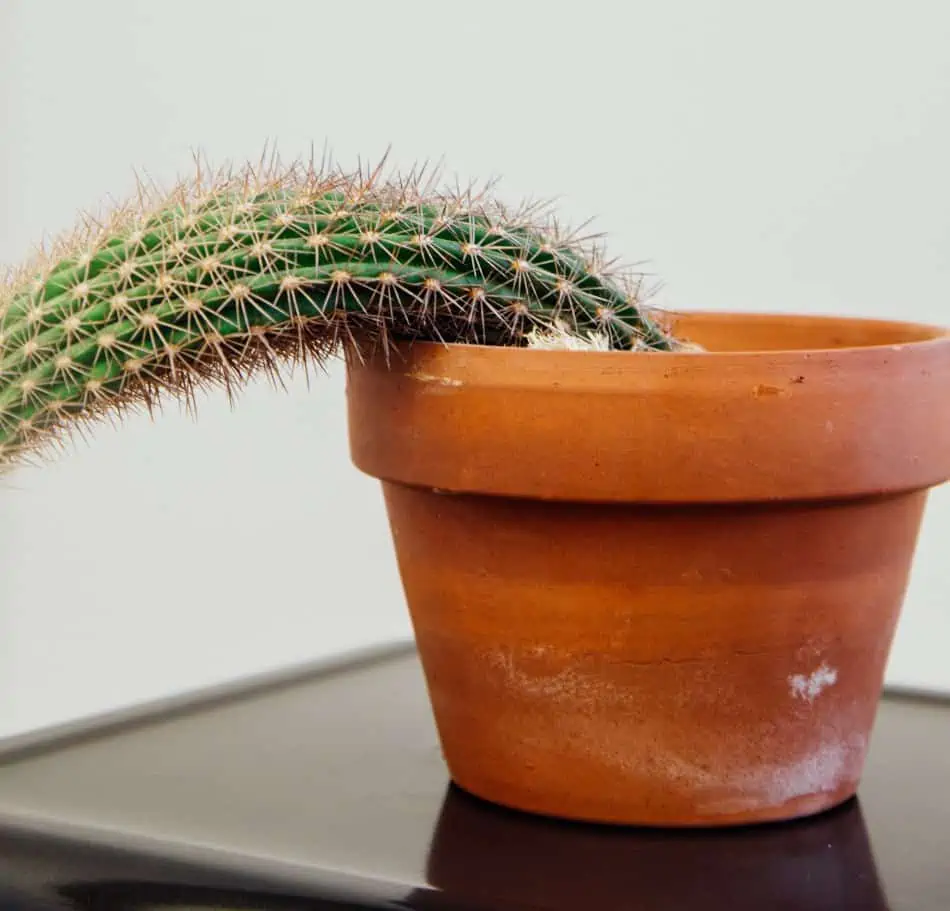
A cactus falling over the clay pot.
Overwatering a San Pedro cactus leads to rotting that makes the plant turn brownish and soft.

A rotting cactus will usually appear brown and feel mushy to the touch. To avoid this problem, make sure that you water your cactus in intervals rather than all at once, and keep the amount of water consistent. If this does happen, stop watering the cactus for a little while. It would also be a good idea to get it out of the overwatered pot and into a fresher, drier pot. The split parts are permanent and can’t be fixed, but that won’t prohibit the cactus from being saved and to continue to grow. 

The Effects of Sunburn Damage 

Sunburn occurs when a cactus has been too overexposed to direct sunlight. It makes the cacti look whitish around the top or on their ridges, and more severe burns make the cactus take on a dark brown look. To treat a cactus with a sunburn, get it to a shady place as soon as possible. If the cactus is already burned to a brown crisp, then the damage is irreversible. To prevent it from happening in the first place, give it full sun exposure for a short amount of time daily, increasing the length of time in the direct sun slowly over the course of a few weeks. 

A sunlight.
Although San Pedro cactus loves sun, overexposure to direct sunlight might lead to severe sunburn damage.

Bug Infestations and How They Harm Your Cactus 

Bug infestations can range from barely visible to bluntly obvious. To check your cactus for bugs, digging around in the soil a bit with a trowel or just taking a good look at it can give you a pretty good idea if there are bugs on the cactus or not. To treat bugs, you will have to physically remove as many bugs as possible from the cactus with a fingernail or some tweezers. If the infestation is of a larger scale, physically removing the plant and washing out the pot is the better option. To prevent any infestations in the future, regularly spraying the pot and the cactus with a light layer of pesticide can prevent an infestation. 

Frost Damage from Cold Temperatures 

Finally, frost damage is what occurs when plant cells that are exposed to freezing temperatures start dying, and the health of the cactus suffers as a result. This also causes the cells to rupture and the water doesn’t hold as well, drying it out. Your cactus is instantly more susceptible to this condition if you live in an area with colder temperatures. To prevent this from happening, bringing the cacti inside or covering them with a tarp can prevent the cold from directly affecting them too harshly. If the temperatures are lower, then a grow light can be a good option to look into. 

Final Thoughts

Growing and maintaining a San Pedro cactus isn’t too hard if you have the right tools. Keeping a close eye on it, making sure it gets the proper care, and taking care of problems when they arise will give the cactus a long and healthy life. 

Review: Leaf And Clay’s Monthly Cactus Subscriptions Box

Imagine the joy of receiving a monthly package filled with delicate, unique, and fresh cacti and succulent plants. Capturing that moment of joy is exactly what Leaf & Clay envisioned when they created the monthly Plant Mail subscription plans. The cacti and succulents are some of the most beautiful plant gifts that can bring a lot of color and vibrance to any space. An added benefit of cacti and succulents is that they require very little maintenance compared to other plants. They create an inviting atmosphere and can be real conversation starters. Each one is perfect for your home, office, studio, or anywhere else you can imagine (as long as it’s a nice, warm place)!

The Leaf and Clay’s goal is to provide unique and high-quality plants, pots, and a lot of greenery stuff for their plant lovers. They are offering monthly subscriptions to inspire their subscribers with perfect quality and their choice of three plants per month. It is well packed in a box with an extra layer of safety that your plants will be delivered without any issues. The best part of their plants are, they are entirely organic with no harmful pesticides used.

A Leaf & Clay home page.
Source: leaf&clay

Cacti & Succulents are Easy to Maintain:

  • Cacti and succulents plants require a lot less care compared to other plants. They need very little water only once a week. 
  • The life expectancy of some cacti and succulents is nearly ten years with the Right Care. 
  • You can put these beautiful plants everywhere in your house. They are small but mighty and incorporate into any decor bookshelves, desktops, windowsills, and countertops.

Leaf and Clay provide value for their community members and send three unique plant gifts each month. You will get excellent quality and a wide selection of organic plants with stylish pots. They offer fast and reliable delivery, which is free with their monthly subscription plan. So, let’s take a closer look at their membership plans.

Helpful Hint: Sign up for their newsletter and get 15% off your first order!

Best Monthly Memberships Plans for Plant Lovers

1. Basic Plant Mail Club Monthly Subscription:

They will provide you with the highest-rated plants of the month. You will receive well-packed sets of 3 cactus and succulents plants such as the Echeveria‘ Ruby Slipper’, Echeveria ‘Mazarine,’ and Polaskia chichipe.

A top view of different kinds of succlents and cactus.
As a Basic Plant Mail Club Monthly Member, you will receive three well-packed cacti or succulents.

Each shipment is hand-selected by their staff and is guaranteed to be uncommon and gorgeous. Never worry about getting the same two plants as each month offers something new and unique! Their team is quite creative, and with thousands of varieties to choose from, you’ll never get bored!

For more information on the Basic Plan, visit Leaf & Clay.

Delivery Duration:

They will provide you fast and reliable delivery of your plants. For your first monthly purchase, you will receive your plant within 1 to 3 business days. The next month, your packages will be processed to go out on the 7th for each month and delivered after 1 to 3 business days. 

Helpful Hint: Your credit or debit card will be charged the amount of your plan on the 7th of each month. You can cancel membership anytime with just simple steps.

Packaging Quality:

Every plant is grown organically with the help of their plant-care experts. The box is sturdy to withstand transportation, and each plant is wrapped gently in protective packaging with the heated or non-heated method, including a pleasant scent. The heated transport packaging is optional and helps avoid damage to the plants during transport or cold weather. With this method, you are guaranteed to find three healthy, fresh plants when you open your box.

A feedback.
Source: Leaf&Clay

2. The Plant Mail Club- 3 Month Subscription: Save (10%) Off

With the Plant Mail 3-Month subscription plan, Leaf and Clay will give three top-notch quality plants for their members. Some plants include Ruby Slipper’, Echeveria Mazarine,’ and Polaskia chichipe.

A multiple plants on a pot.
With a 3-month subscription plan, you save 10% and receive 3 high-quality cacti and succulent plants each month.

This plan is perfect if you or someone you know is a super plant lover. Each plant is the highest-quality, organically grown, handpicked by the staff, and affordably priced with extra discounts!

For more information on the Three-Month Plan, visit Leaf & Clay.

Discount and Details:

The subscription is a reliable and excellent choice for beginner buyers. You will be getting three plants each month for three months time frame. That’s a total of nine gorgeous plants! You will receive 3-packs of succulents with a size of 2.5′ every month, exclusively for Plant Mail Club Members. On top of all that, they include fast, FREE shipping for all our Plant Mail Members.

Helpful Hint: This plan helps you bundle your plants and save monthly. 

Packaging and Delivery:

Leaf and Clay offer you fast and guaranteed damage-free delivery, which will arrive from 1 to 3 business days. The box packaging is meticulous, and you will get two options when it comes to packaging. You can choose the heated or non-heated packaging options. There is an extra charge for the heated option, but it is worth it to help protect your new little friends from damage during shipment. The warming insert will protect them for up to 72 hours, and that is adequate to withstand transport to your door. It is mostly recommended for the winter months, as it shouldn’t be necessary during the summer.

3. The Plant Mail Club- 6 Months Subscription (SAVE 20%):

Leaf and Clay offer their biggest subscription for the 6-Month subscription plan! With this Plant Mail Membership, you will get three pieces of 2.5″ succulent plants monthly. Leaf and Clay subscribers will get this unique succulent with fast delivery of three organically-grown plants. Each one is unique, and you’ll never get the same two! They will be all well-tagged with their name and details about each variety. 

A person arranging the small pot with multiple small plants.
A 6-month subscription plan allows you to save 20% and receive three 2.5-inch tall cacti and succulents monthly.

This deal provides the most significant value at a 20% savings and a total of 18 beautiful plants. It’s the gift that keeps on giving! This subscription is perfect for a house-warming gift, wedding gift, keep it all to give yourself a little reward.

For more information on the Six-Month Plan, visit Leaf & Clay.

Packaging and Delivery:

As with the other plans, the packaging and delivery are fast and responsive. Your delivery will get processed automatically on the 7th of each month and delivered in the next 1 to 3 business. You will get stylish pots along with the plants, all wrapped gently and protected perfectly. The delivery box will be secure. For added protection, you can order a heated box that will help to save your plant from any damage.

Benefits of Having Cacti and Succulents

Leaf and Clay have an excellent reputation for providing low maintenance, high-quality cacti, and succulent gifts. They are a perfect choice for both beginners and experienced succulent aficionados. 

Because each one experienced the same high level of care during the growing process, you won’t need to worry about receiving a sickly plant. Each one will appear relatively uniform in height, and the complimentary pots mean each one will tie together perfectly with any decor.

A top view of a Succulent and cactus on a pot.
Having cacti and succulents indoors helps you decorate the area and brings tons of health benefits.

The cactus plants bring a pleasant feeling of relaxation and provide an overall more tranquil atmosphere no matter where you put them. Enjoy a burst of color, sprinkled all around your home or office. 

There is a reason that cacti and succulents are so loved and appreciated by people around the world. 

Many people believe they carry with them the spirit of the desert and have used them for healing throughout the ages. You can breathe a little easier when they’re around as they also help remove pollutants from the air. 

A feedback.
Source: Leaf&Caly

Multiple Size Options

Cacti and succulents are available in many different dimensions, sizes, and shapes. You can find fascinating varieties of the same or varying qualities such as the 2.5, 3, 4, and the newest height of 6 inches tall. The Leaf and Clay provides a well-packed delivery box wrapped with tissue paper and protective packing layers. They offer a wide variety of plant types, pots, accessories, and more! You’re sure to find the perfect one that speaks to you!

The Verdict

Everyone can use cactus and succulents for improving the decoration and beauty of their home, office, studio, or any other space. Indoor plants bring many benefits, but none are as easy to take care of as cacti and succulents. One of the best things about cactus and succulents is that they don’t need any effort to maintain and do not need much sunlight or a specific environment. As long as it is warm and dry, your plants will be quite happy.

Shopping for succulents online is not as hard as it once was, as more customers are turning to Leaf & Clay to provide them with the best service and highest-quality fresh indoor plants. Leaf & Clay gives a perfect view for indoor, fresh air and sets the mood with a premium vibe. They have an excellent reputation and reviews from thousands of happy customers. 

Leaf & Clay offers a fantastic selection of cacti and succulent varieties, pots, accessoriesapparelgift cards, and more!! Their goal is to provide the best quality at an affordable price, and they achieve that quite well. It’s no wonder they’re the fastest-growing online succulent store. 

With their help, you can create a masterfully-curated collection of beautiful succulents complete with one-of-a-kind pots, cradled in artfully designed macrame hangers. Don’t hesitate! Check out their collection today and find the perfect give for your loved one, coworker, or as a sweet little treat for yourself.

Join Leaf And Clay’s Monthly Cactus Subscriptions Box HERE

How To Plant A Cactus?

A cactus can add a lot to your yard or home. They can add personality to every facet of your life, and there are more than 2,000 species to choose from. They’re also low maintenance, so almost anyone can grow them. But many people are intimidated by the cactus and need some help in learning to plant a cactus. 

It can be tough to plant a cactus without getting the prickly spines in your fingers. It can also be a challenge picking the right dirt for the right cactus. Cacti need bright sunlight most of the time, along with the right soil and digging the hole to the right depth.

Read below to find out exactly how to plant a cactus, pain-free. You’ll see the correct soil type to use as well as the conditions cacti need to thrive.

Indoor Cacti

Before you plant your cactus, there are some decisions you will have to make. The first decision facing you is whether you want to plant indoors or outdoors. There are pros and cons to each. Consider the below for indoor cacti.

Benefits of Indoor Cacti

Cacti need a certain type of weather to survive outside. If you don’t live in a dry, hot climate, it may be best to consider planting your cactus inside in a container.

A person holding a cactus on a pot.
Indoor cacti require low maintenance and can help you with breathing, concentrating, and relieving stress.

There are several benefits of indoor cacti, and they’re very easy to grow inside. If you have limited space or live in a cold climate, consider these benefits for growing your cactus indoors:

Benefits of owning cacti include:

  • Breathing Better – Your cactus will absorb carbon dioxide. That’s a very good thing for you since it will convert that carbon dioxide into oxygen for you to breathe
  • Increased Productivity – Cacti improve our concentration and provide a calming effect for the home
  • Healing – As well as relieving stress, some cacti, such as agave or aloe vera, have healing properties. Aloe vera treats burns and bruises. Agave can help heal cuts and burns
  • Low-maintenance – Cacti can thrive in your home. Just find a sunny window, and you can add a bit of nature to your space.

There are many different beautiful types of indoor cacti, including:

  • Christmas Cactus A Christmas cactus will put off bright pink blooms yearly but requires more watering and a more humid climate
  • Moon Cactus – A very bright cactus, but they have very short lifespans compared to other cacti
  • Easter Cactus – Very attractive plant that blooms in early spring

Although these are just a few types of cacti that could suit your home well, there are many others to choose from.

Now that you know the benefits and a few types to choose from, it’s time to really think about your planting.

Choosing the Right Soil

If you want your cactus to live a long time and thrive, you need the right type of soil. For any type of cactus, you will need the following.:

  • Sandy
  • Porous
  • Pebbly
  • Good Drainage
  • Good Aeration

The soil will need to be able to dry quickly after being watered. Cactus roots can deteriorate quickly if left in water. 

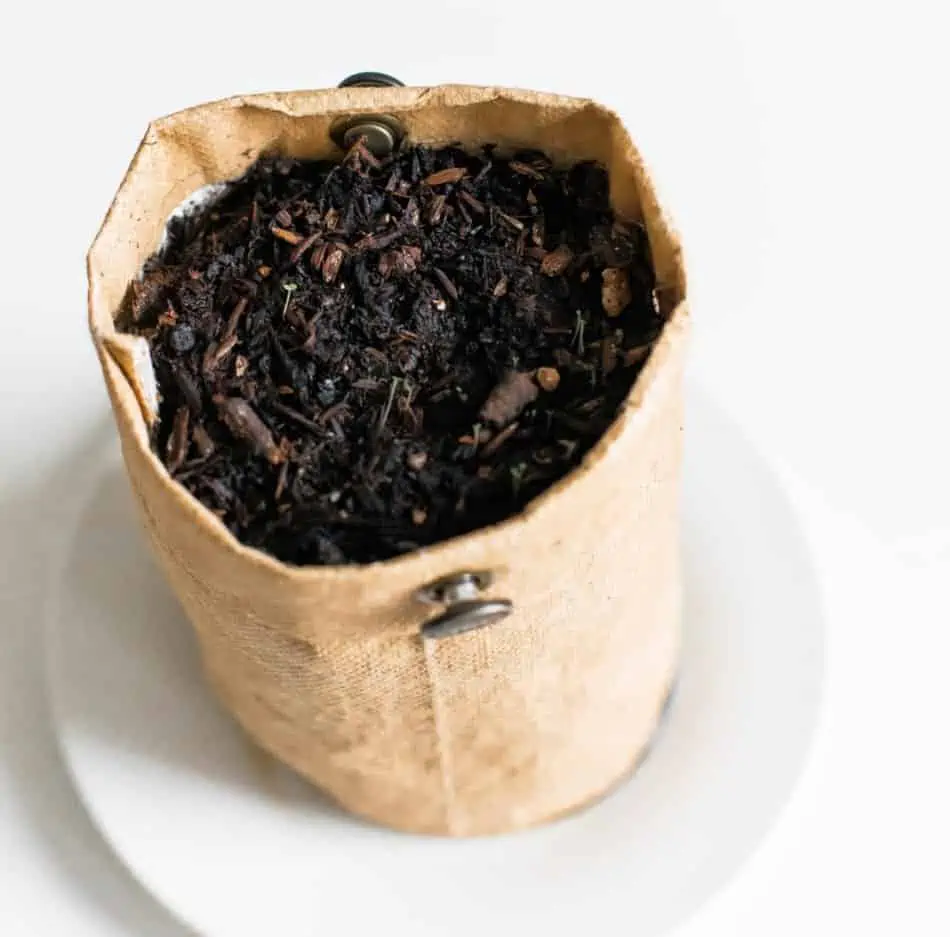
A soil on hand,
Sandy, porous, and pebbly soil offer excellent drainage and aeration for any type of cactus.

You can get a potting mix specially made for cacti at any lawn and garden center. These mixes mimic the correct soil a cactus in the wild would normally have. If you don’t want to pick up a commercial mix, you could make your own.

Here are some great tips to have the best soil for your cactus:

  • Particle size ingredients should be 1/4 inch big for aeration
  • Needs soil with a PH of 5.5 or 6 – get a PH tester
  • Use rainwater to keep PH balanced
  • Use organic matter like peat moss or decomposed leaves
  • Water the soil before planting to allow the organic material to absorb the water
  • Add pumice to mix to improve water drainage

The correct soil mixture is critical to your overall cactus health. If you don’t get the soil right, the cactus will not survive very long. 

Choosing the Right Container

The most important issue with picking the right container is making sure it has at least one drain hole. Cactus roots don’t need to sit in water and will rot if they do so. Drainage and the right soil will take care of that problem. 

There are many different kinds of containers to choose from. Shallow containers are fine for cacti since they have very shallow roots. In fact, you should choose a container just big enough to fit the cactus.

If using a clay pot, increase the size of the drainage holes in the bottom of the pots to better the drainage of the containers.

Potting Your Cactus

Once you choose your cactus, soil, and container, it’s time to pot your cactus. Here are some tips to make sure it goes smoothly:

A person repotting the plant.
The right way to pot a cactus is to fill 1/3 of the pot with soil and then place the plant inside.
  • Get a pair of tongs or thick gardening gloves, so you don’t get pricked by the cactus spines
  • After filling the pot about 1/3 full with your soil, center cactus in the container
  • Use tongs to hold cactus while you fill in the remaining space with your potting mix
  • Leave a little space at the top of the container with water
  • Press soil gently down among the roots of the cactus
  • Shake the pot a bit to settle the soil
  • Try to place the container in a South or East facing window
  • Water your cactus

It’s not that difficult to plant a cactus but you do have to be careful to not get stuck on those cactus spines. 

Outdoor Cacti

If you prefer to plant your cactus outside, you’re going to have to choose a very sunny spot. Location will be everything to help the cactus or cacti thrive. Read below for the best ideas on planting an outdoor cacti garden.

A prickly pear cactus on a pot exposed to sunlight.
Location will be everything to help the cactus or cacti thrive.

Planting your Outdoor Garden

You will need a dry, hot climate to grow your outdoor cacti. These plants are drought tolerant and don’t need a lot of moisture. You can use cacti to enhance your landscape or you can do a garden completely out of different cacti.

You can also choose to plant your cacti in containers so you can move them inside in the winter. Just remember that some cacti grow very large and may prove impossible to get in during the winter after a certain point. If you do choose containers, try unglazed terra-cotta planters because they’re porous and can whisk away moisture.

You should make sure your cacti have sufficient space in your garden. Cacti can grow very large and some species even grow horizontally so you need to take all that into account and ensure your garden is not over-crowded. 

Before you leave the lawn and garden center, check your plant for firmness and to see how thick it is. You will want to choose a thick, firm plant. The thick flesh will let you know if it can store water for a long period of time. 

Plant selection is critical when you’re dealing with cacti. Make sure that you choose a cactus designed to grow in your region. Below are some popular types of cacti used in outdoor gardens:

  • Beavertail Cactus – A prickly pear cactus with blue-green pads, this grows wider rather than taller and has deep pink blooms
  • Golden Barrel Cactus – Can grow up to 4 feet tall and is very good in drought-tolerant areas
  • Saguaro – Can be grown indoors or outdoors but can get to a height of over 50 feet when fully grown so best to be transplanted outdoors at some point. One of the most iconic looking cacti in the world
A matured golden barrel cactus.
Golden Barrel is one of the most popular outdoor cacti species that can grow over 50 feet in height.

Depending on your region, you can choose the best cactus for your garden. Cacti can be grown in the ground or raised beds. Almost all require little water and a lot of sun. 

Picking the Right Soil

Choosing where you plant your cacti outside will be of major importance. Like real estate, it’s all about location, location, location. To make sure you have enough drainage and aeration, you may choose to use a potting mix rather than the soil found naturally in your yard. 

You can even make this potting mix at home, using only three items::

  • Potting soil
  • Coarse sand (like sandbox sand)
  • Pumice or Perlite (for good drainage)

Whatever potting mix you use, make sure your cacti has a lot of drainage. You do not want root rot on your cacti so drainage and aeration will be key.

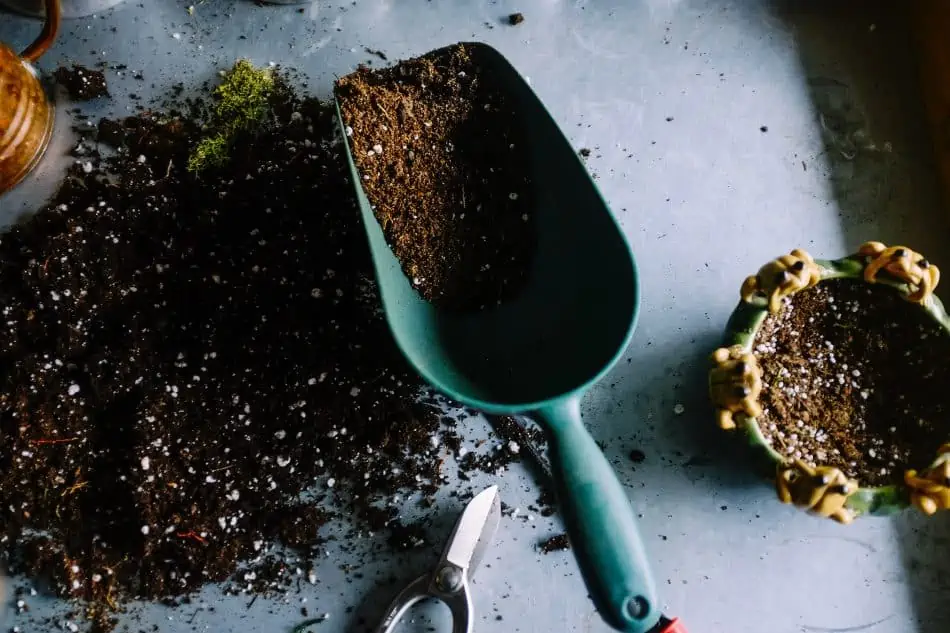
A soil fertilizer.
To make the soil perfect for your cactus, consider adding supplements, including Pumice, Perlite, Haydite, and more.

Here’s how to figure out if you need to alter the soil in your yard for your cacti: Dig a hole. Yep, it’s that easy. Dig a hole about a foot deep and fill with water. Wait 30 minutes and check it. If water is still standing in the hole, that soil is not draining well enough and you will need to add rocks or sand to the soil to create better drainage. 

Here are some other items you could use to supplement the natural earth in your yard:

  • Japanese Hard Akadama – A clay-like material that can be combined with sand for a rich soil mixture. It retains water so don’t use too much
  • Pumice – A volcanic and porous rock that’s great for drainage. Leaves a lot of space for air
  • Perlite – This retains moisture and drains water well, making it a great fit for cacti
  • Vermiculite – Good at soil aeration and water retention
  • New Zealand Pine Bark – Can last for years and holds water
  • Haydite – Absorbs excess water and slowly releases it back into roots
  • Coco Coir – Absorbs excess water and dries out quickly. Rot-resistant
  • Sand – Excellent for drainage. Mix with potting mix for better drainage. Use construction-grade sand

Your soil mix will be critical to your growing success. Make sure you match the potting mix with the cacti, as some need more water than others. If you don’t choose the right soil mix, or work the soil to make sure it is correct for your cactus, you will not have a lot of success in growing cacti. 

After you mix your soil and put it in your hole, make sure you water the area for about an hour. You want the absorbent materials in your potting mix to absorb all the water it can so it can slowly release it back to the cactus roots after planting. 

Planting Instructions for Outdoor Cacti

You will want to plant your cactus when the roots are actively growing, preferably from late spring through summer. You will also want to pick your location, which should be in an area that gets mostly to full sun.

A gravel on sand.
To grow a healthy cactus outdoors, it is important to select the right spot and prepare the soil accordingly.

After choosing your location, here are the instructions for planting cacti in your outdoor garden:

  • Prepare the soil in your planting area
  • Dig a hole that is as deep and 1 1/2 times as wide as the root ball or stem
  • Get some tongs or thick gardening gloves to handle cactus
  • Set the cactus in the hole so that the north side of the cactus faces north. You may have to ask at the lawn and garden store which side of the cactus is north
  • Fill the area around the root ball with potting mix and pat down gently
  • Lightly water (remember you should have prepared soil previously with water)

Immediately after planting, you may want to give your cactus some shade until the roots become attached. You can use shade cloth or some type of plant near it that offers temporary shade.

After initially watering, wait at least a week to water again to give the cactus a chance to heal and take root. After that, all you need to do is weed your garden and throw out some occasional fertilizer.

That’s all there is to it. Planting a cactus is easy if you do the prep work right. Choosing the right cactus with the right location and soil is important to your overall success and will mean the difference between a thriving garden and one full of dead cacti. 

Growing Cacti From Seeds

You can grow cacti from seeds rather than an already growing plant, but it will take some time since cacti are notoriously slow-growing. Below are the items you’ll need to grow cacti from seedlings:

  • Cacti seeds
  • Small plastic pots
  • Clear plastic bag
  • Free-draining compost
  • Vermiculite
A seeds on hand.
Growing cacti from seeds will take more time than growing from cuttings.

Fill the small plastic pot with the compost and gently tamp down on the mix. Scatter cactus seeds on the top of the compost and place a small layer of vermiculite over the seeds and compost, covering completely. Leave on a warm east or south-facing windowsill and cover with a clear plastic bag. Remove the plastic bag and spray with water regularly, to keep the compost moist. In a few weeks, you’ll have your seedlings.

Remember you will have to transplant your seedlings in the following spring to a small terra-cotta pot. 

Tips for Growing the Best Cacti

Cacti are incredibly low-maintenance succulents but there are some tricks and tips to get the most out of these plants. Whether you grow inside or outside, consider the below to grow your best succulents ever:

  • Always grow in bright light, either inside or outside
  • Make sure all cacti have access to direct sunlight
  • Wait to water until the top 2 inches of soil are dry
  • Don’t underwater cacti, especially during the growing season of spring and early summer
  • Do not prune cactus
  • Using gloves coated with Nitrile will protect your hands from getting pricked by spines
  • Consider layering gloves
  • Use a soft grip
  • For most cacti, you will need at least 6 months of 70+ Fahrenheit weather
  • Do not use large pots for your cacti – they typically grow very slowly
  • If grown in a container, you only have to transplant every 3 to 4 years
  • If you use fertilizer, it should be specialized for cacti
  • There are different potting mixes for tropical cacti than there are from desert cacti – use the correct mix
  • When planting a cactus garden outside, mix in some other succulents and aloe to give a professional look
  • Adding small pebbles will also give your garden a professional look

These are simple tips and shouldn’t give you much trouble but they can make a big difference in either an indoor or outdoor garden.

The Final Word

Any type of cacti will be a great addition to your garden. They’re easy to grow and easy to maintain. The main problem cacti have is that most people either over or under-water them. 

Other than watering, the main items you’ll have to remember are the type of soil to use and the location of your cacti. Remember that cacti need full sun and little water. Watering two or three times a week for an outdoor garden and once or twice a week for an indoor cactus should be sufficient. 

Being so low-maintenance, they also make great gifts, as it can be hard for anyone to completely kill a cactus. Whichever cactus you choose for your garden, remember not to stress and just enjoy the process. Happy gardening!

How To Grow An Opuntia (Prickly Pear) Cactus

Growing an Opuntia cactus in your yard may seem a bit unfriendly at first glance. But this desert plant has recently fallen into favor with homeowners for all the right reasons. Opuntia cacti add beauty and charm to any garden.

Opuntia Cacti are almost maintenance-free plants that can thrive in most soils as long as they are well drained. The one thing a cactus cannot tolerate is the wet. Some can withstand cold temperatures; others need mild to warm conditions year-round. Let’s take a closer look at how to grow an Opuntia cacti.

Opuntia Cactus may be grown from cuttings

  • With a sharp knife, carefully remove the pad
  • Place the pad on end so it does not curl while a scab forms over the cut end
  • When cured, (2 weeks or longer) dip the pad in a Bordeaux mixture to ward of fungal infections
  • Plant the pad upright one inch deep in a half-and-half mixture of sand and soil
  • Anchor with rocks to keep the pad upright until roots form
  • Water after one month; then water only when soil is dry
A person propagating the plant.
To grow the Opuntia cactus from cuttings, carefully obtain the pads and plant them upright using the right soil mixture.

Opuntia can be grown from the seeds found inside the fruit

  • Rinse the pulp off the seed, and make sure you let it fully dry before planting it. 
  • Potting soil is fine for planting Opuntia seeds if the soil is well drained. Spring seems to be the best time for planting Opuntia seeds.
  • A seeded Opuntia takes three to four years to flower and produce fruit while an Opuntia grown from a cutting will flower and bear fruit within its first year. For this reason, it is most common to propagate the species using cuttings.
  • The Opuntia can reseed itself from just one of the pads or “leaves” that has been severed from the mother plant.
  • It is not difficult to grow an Opuntia, but it does take patience and careful attention to detail.
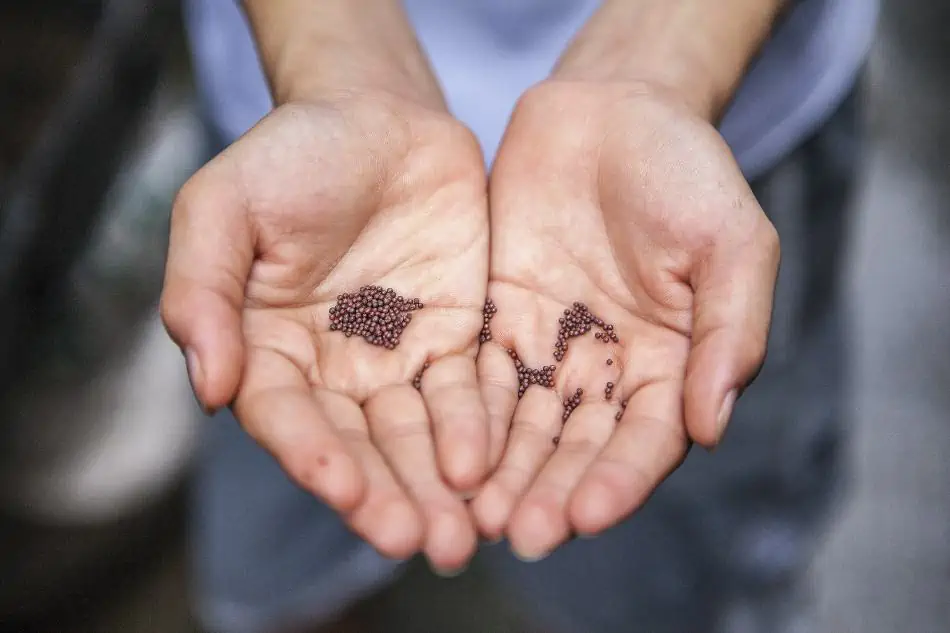
A cactus seeds on hand.
You can obtain the seeds from your Opuntia fruit and plant them, ideally in Spring.

To grow an Opuntia from a cut pad, you need to select a pad that is at least six months old

  • Sever it from the mother plant using a sharp knife. 
  • Place it upright so it doesn’t curl while a scab forms over the cut end. This will take at least two weeks in dry areas; longer in humid areas.
  • Once the scab has formed, dip the cut end of the pad in a Bordeaux mixture made of 3 1/3 tablespoons of copper sulfate and 10 tablespoons of dry hydrated lime in one gallon of water. This protects the pad from fungal infections.
  • Plant the pad upright one inch deep in a mixture of equal parts sand and soil. Use rocks to stabilize plant until roots form. Do not water the plant yet; this may cause root rot. As a native desert plant, the Opuntia doesn’t need much water.
  • After one month, roots should have formed, and the pad should be able to hold itself upright. At this point, it may be watered. After that, it should not be watered again until the soil is dry.
  • Place in full sunlight, if possible. 
  • A balanced fertilizer may be added monthly, if desired. For larger pads, use a fertilizer high in Nitrogen. For fruit and flowers, use a Nitrogen-free fertilizer.

Be sure that you always wear sturdy work gloves when tending your Opuntia. The tiny glochids that cover the entire surface of the plant and fruit are quite painful when touching bare skin.

Plant or Pot Works Well

It is most common to plant Opuntia cacti outdoors, especially in warm, dry climates where the soil drains well. But they may also be potted. If you choose to pot your Opuntia, be sure the pot is large enough to accommodate their gangly size.

A person repotting her plant.
Although Opuntia cacti grow better outdoors, you can also pot them using a large container.

Opuntias will need to be transferred to larger and larger pots as they continue to grow. Depending on the variety of your Opuntia, this task may require two people to stabilize the cactus for transfer to avoid breaking the plant.

Keep It Drained

The soil your Opuntia lives in needs to be well drained. Opuntias get root rot from living in soggy soil. Watering should be restricted to about once every two weeks during the summer and about once a month in the winter.

You Can Eat Them

Opuntia pads are edible, at least, most of them are. Don’t let the bristles intimidate you; just don a good pair of work or welding gloves and harvest your cactus.

One way to escape being mauled by glochids is to grip the pad with a pair of tongs and cut it from the plant with a knife. You’ll want to choose young, tender pads for this. 

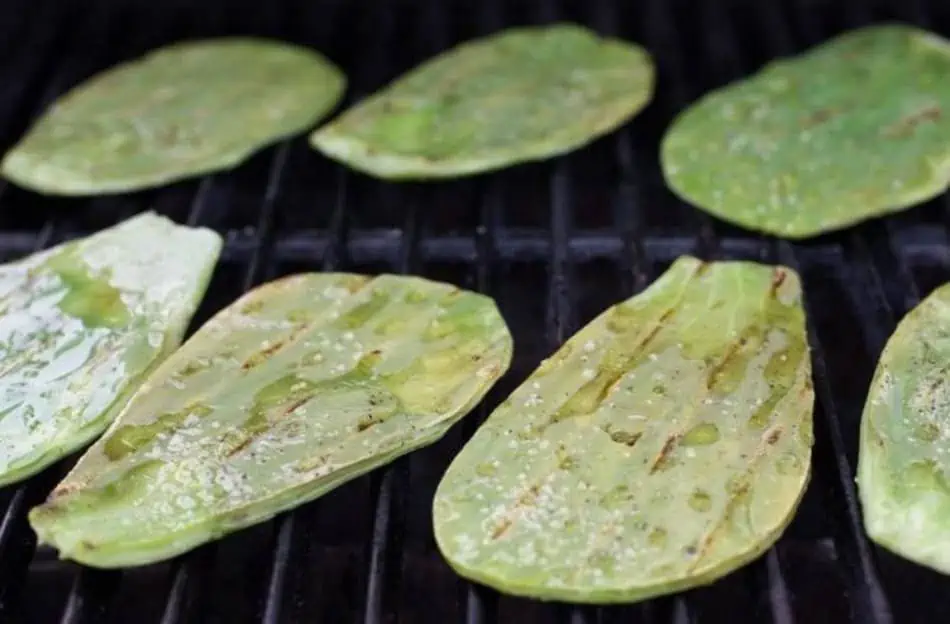
A grilled prickly pear pads
Prickly Pear pads are edible but you will need to remove all the glochids and spines thoroughly.

The best time to harvest cactus pads is midmorning to midafternoon. The acid content is lower at these times making for a more palatable taste. For a mature cactus, approximately one-third of the pads should be harvested yearly to keep the plant at optimal health.

After gathering the pads, you can scrape the bristles off with a blade under running water or burn them off over an open flame.

Prickly pear pads can be eaten:

  • Raw
  • Fried
  • Boiled
  • Sauteed
  • Made into soup
  • Added to a salad
  • Added to an omelet

Prickly Pear Cactus Fruit Is Versatile

The red fruit of an Opuntia is called 

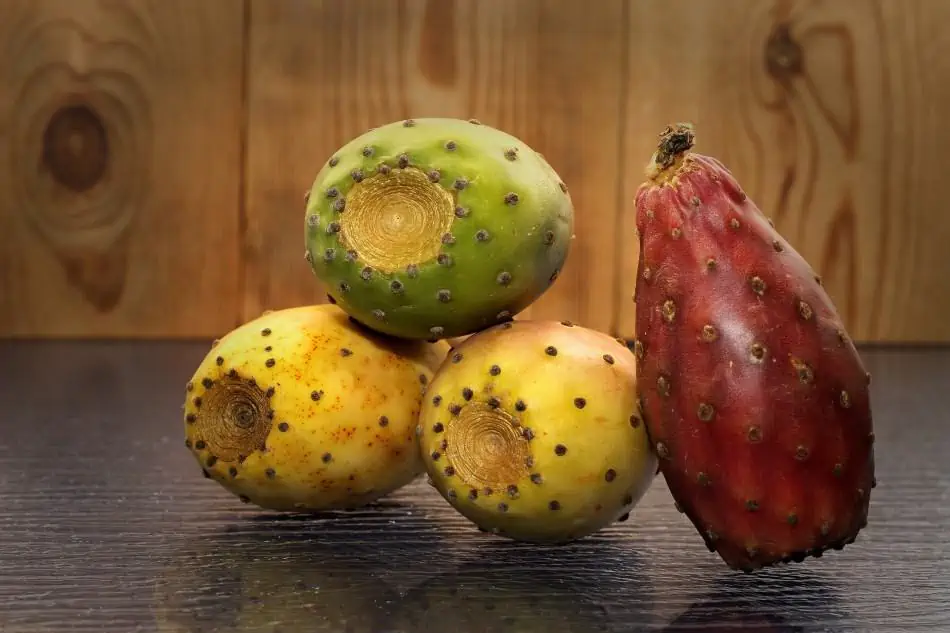
A prickly pear cactus fruit.
Prickly Pear fruit carries tons of health benefits and can be eaten after removing all the glochids.

It is edible cooked or raw, but care must be taken to ensure that all the glochids have been removed. If ingested, glochids can cause irritation to the 

  • Lips
  • Mouth
  • Throat
  • Digestive tract
  • Stomach

To eat the fruit raw, it is commonly split in half and the insides are scooped out with a spoon or it is peeled and eaten whole. These fruits are used in a variety of ways. They can be made into

  • Syrups
  • Preserves
  • Jellies
  • Liquor
  • Herbal remedies
  • Juices
  • Smoothies
  • Pancakes
  • Desserts
  • Candy

The fruit ripens at the end of summer. Most varieties turn a deep red on the outside when fully ripe.

Cactus fruit drinks.
To eat the fruit raw, it is commonly split in half and the insides are scooped out with a spoon or it is peeled and eaten whole.

To harvest cactus fruit, use thick gloves or a towel that is folded several times. Grasp the fruit and twist. If fully, ripened, it should come off the plant with little effort.

Grow an Opuntia Almost Anywhere

The Opuntia Cactus, also known as Prickly Pear Cactus, comes in many varieties. Some grow huge, up to fifteen feet tall while others are quite miniature at just six inches tall. 

This makes them a versatile shrub that can be grown:

  • Indoors
  • In sunrooms
  • On porches
  • Outdoors
  • In gardens
  • Along property lines
  • In xeriscapes
A fruit bearing prickly pear cactus.
Prickly Pear cacti can grow almost anywhere on earth and this is want makes the plant so desirable worldwide.

They all flower, usually in the spring or early summer. Their flowers can be:

  • Red 
  • Yellow
  • Purple

Some have sharp spines, but most have glochids which are short, very fine hairs that grow all over the pads. These glochids easily detach from the pad and stick to skin, causing severe irritation. They are almost invisible and quite difficult to remove, so the use of gloves is recommended when touching an Opuntia.

Why Would You Grow an Opuntia Cactus?

For those in humid areas, it may seem a bit odd to plant a cactus in your yard. But if you have ever been to the desert, you understand how big a piece of your heart you leave behind. Something about the Old Wild West still intrigues us, and we want to bring it home with us however possible.

One way we can do that is by growing Opuntia cacti in  

  • Rock gardens
  • Yards
  • Flowerpots
  • Sunrooms

These hardy plants require little tending so if your green thumb turns plants brown, this is one species you should have good luck with. Besides that, they’re just beautiful! 

A bit intimidating because of their self-defense system, but mysterious and intriguing. They produce that arid feel of the desert. In a sense, they give us a chance to relive the Wild West days. 

Pick Your Opuntia

In all, there are about ninety different plants that are classified as Opuntia Cacti, or Prickly Pear Cacti. We will not study each one in depth here. We’ll only explore the species that most often end up adorning somebody’s rock garden or patio. 

Opuntia Microdasys

This species is known as the “bunny ears” cactus because the pad shape resembles a rabbit’s head. This cactus is relatively small, usually maxing out at around 60cm tall. This makes it the ideal species for growing indoors or in flowerpots.

The young plant is red and turns green as it grows older. When fully mature, this species will grow red or purple fruit. The fruits of the bunny ears cacti are edible, but extreme caution should be exercised when harvesting them. They are covered with almost invisible glochids.

Its flowers which bud in late spring are yellow and measure approximately two inches across. 

The Microdasys should be planted in full sun, if possible. At the most, it should be in only partial shade. A low-Nitrogen fertilizer should be used every other time it is watered. This cactus requires regular watering throughout the summer but shouldn’t be watered at all in the winter. 

This variety of Opuntia Cactus is not cold hardy. It should be kept in temperatures exceeding 45*F year-round.

Opuntia Basilaris

This Opuntia species has the “beaver tail” shape. It is a good option for growing indoors since it rarely grows more than sixty centimeters tall.

 Its gray-green or blue-green pads grow up to fourteen centimeters long and ten centimeters wide. They are fan shaped resembling a beaver’s tail. In dry summers they turn purple and wrinkle a bit but fill out again during the winter rains. 

The Basilaris has no spines, but it is loaded with glochids, so caution must be used when tending it. Its magenta-colored flowers are quite the star of the show as the plant itself is not attractive at all without them.

Native Americans used to depend heavily on the Basilaris buds as a source of food and medicine. Even the large, coarse seeds were ground up and used to make mush. 

The fruit of a Basilaris is brown gray in color and oblong in shape. It is not so readily consumed because it tends to be rather dry.

This is a low maintenance species that does well whether planted outdoors or potted indoors.

Opuntia Ficus-Indica

This is by far one of the most popular species of cacti grown literally all around the world. Most prickly pear recipes refer to this species. 

Topping out at sixteen and a half feet tall, this is one giant of a shrub. For this reason, it is not a good choice for an indoor plant, but it can successfully grow in pots. More often, this will be the cactus you find dominating a rock garden or xeriscape. 

A Opuntia Ficus-Indica with fruit.
Opuntia Ficus-Indica is the most popular Prickly Pear species that is characterized by orange-yellowish flowers and red fruits.

Its pads are thick and oblong, about two feet long and ten inches wide. The surface of the pads is waxy which causes them to reflect sunlight very well. 

From one year to two years old, the Ficus-Indica starts to produce yellow or orange-yellow flowers in the spring or early summer. Soon after, its fruit appears and turns red as it ripens, generally from August to October.

Is It Fruit or Vegetable? It’s Both!

Its red fruit is edible and so are its pads. The most popular way to eat Ficus-Indica fruit is peeled and chilled. It tastes like watermelon and contains myriad tiny seeds which are usually ingested along with the fruit, although this should be avoided in the presence of digestive issues.

These fruits contain the most Vitamin C of any fruit in the world. In fact, it has been proven that the health benefits of eating cacti comprise quite an impressive list.

The stems of the Ficus-Indica tastes much like a string bean. They are used extensively as a vegetable side dish or as a sort of stir-fry to some main dish like chicken or tacos.

 The Ficus-Indica is so popular because it’s so versatile. The pads can be eaten as vegetables and the fruit as dessert, or both can be used as medicine. The different components of the Ficus-Indica are used to make everything from dinner entrees to alcoholic beverages.

Especially in Mexico, the pads and fruits from this cactus are considered a delicacy. But food isn’t the only use of this cactus. 

Upgrade Soil with Cacti

In desert places like the Mediterranean, it is used to slow soil erosion and the shifting of sands. It also improves the quality of soil by replacing Nitrogen and organic matter into the soil.

Ficus Fills the Cows

In the US, the cattle industry has begun using the spineless variety to feed cattle on the desert ranges. Not only is it a cheap food, but its water content is so high that it reduces the need to water the animals who consume it.

Fuel Up with Ficus

Since the Ficus-Indica readily converts water into biomass, Mexico has developed a pilot plant for using the biomass form the Opuntia Ficus-Indica to produce a sort of biofuel.

This species grows very fast and is relatively maintenance free. It is extremely hardy, capable of withstanding temperatures as low as 10 F. It only needs full sun and a little water now and then.

This is one plant that gives back far more than it takes!

Opuntia Santa-Rita

The Santa-Rita grows more slowly than the Ficus-India, but it is well worth the wait. The Santa-Rita can put on a color show like no other cacti.

This variety of prickly pear produces flat pads in colors of

  • Purple
  • Pink
  • Red

The colors can change at times when influenced by climatic conditions. The depth of color in the pads increases during

The purple color fades a bit with too much water, and in warmer temperatures, the pads turn bluish-green. 

What makes this plant so interesting is the stacking of colors. The mature pads are blue-green while the young pads are purple or pink. Top that with red or yellow flowers and you have quite the painted desert show!

It needs to be watered only during the hottest summer months whenever the pads start to wrinkle or appear thinner than usual.

Its flowers can be yellow or red.

Santa-Ritas produce a small purple fruit that is edible, but you’ll have to fight with the birds for it. It seems that Santa-Rita fruit is their favorite snack.

This cactus does best when it receives six or more hours of full sun daily, preferably on a southern or western slope. With this species reaching a height and width of up to five feet, it does best when planted outside with plenty of room away from other plants.

This cactus is mostly trouble-free, and can tolerate cold temperatures, even frost with no problem.

Cacti Never Looked So Good

While they must be handled with care to avoid personal injury, Prickly Pear Cacti provides a unique and rustic feel to their surroundings. Whether indoors or out, they have a way of reminding us of simpler days, of adding rugged beauty and charm in return for so little care.