Which Succulents Go Well Together in a Succulent Arrangement?

Do you want to create a perfect succulent arrangement that will add life to your garden or indoor spaces? If so, then there are a few things you need to know about pairing these sun-loving plants. Most succulents already look fabulous on their own, but they can look even better when they are arranged together. The primary goal is to know which succulents can be grown together to save your time and effort in caring for the plants.

So, what succulents go well together in a succulent arrangement? The truth is that there are many types of succulents, and if you want to arrange these plants, a general rule is to choose those with similar needs. If you pair succulents with similar needs, they will grow in harmony and maintain a beautiful appearance throughout their time together. Mixing plants with different needs will not do you any good. For instance, Graptosedum California Sunset is a wild summer grower, while Crassula is a winter grower. So, planting these two together wouldn’t be a good idea at all.

This article discusses critical things you need to evaluate when determining which succulents go well together to avoid losing some of the plants. Read on to learn more.

Which Succulents Can Be Paired Together?

Almost all kinds of succulents can be paired together, but you still need to consider a few things to ensure your pairing and arrangement will survive over the long term.

When choosing which succulents to plant together, the most critical considerations are the conditions for maintenance and the general growth period. Basically, you want to combine succulents with similar care requirements and grow the same season.

Their watering needs, temperatures requirements, light requirements, humidity requirements, and even fertilizer requirements should be similar.

You should also pay attention to other things such as their form, color, and texture, which are crucial to developing a visually-appealing succulent arrangement.

So, what criteria should you follow when determining which succulents can go well together in your succulent arrangement? Let us find out.

1. General Care Requirements

Most succulents are generally easy-care plants. They all can store water in different parts (roots, stems, and leaves) and are drought-resistant.

However, you need to remember that some succulent species require more water than others. Some prefer exposure to full sunlight, while others thrive under shade. Some succulents are winter-dormant, while others are summer-dormant.

Hardy succulents can easily withstand freezing temperatures and frost, but the tender species are less tolerant to extremely harsh weather conditions.

Succulents on hand.
Remember that some succulent species require more water than others.

Therefore, when planting succulents together, consider their general care needs such as water requirements, growth season, temperature, and light requirements.

Generally, succulents with thin leaves usually require more water than their thick-leaved counterparts. So, if you mix thin-leaved and thick-leaved succulents and supply them with the same amount of water, you risk losing one of them due to either underwatering or overwatering.

If you must plant them together, then you will be forced to give the thin-leaved succulents a “direct dose” of water while trying to leave the other succulents dry. This alone can turn out to be a lot of work which you can avoid if you choose your succulent pairings carefully.

2. Height

Besides the growth needs, it is also good to consider the height of your succulents while planting them together. Generally, your succulent arrangement should have a thriller, filler, and spiller.

Choose the tallest succulent you can lay your hands on as the thriller because its primary job is to make the entire arrangement look outstanding. Relatively shorter succulents can be used around the thriller as fillers.
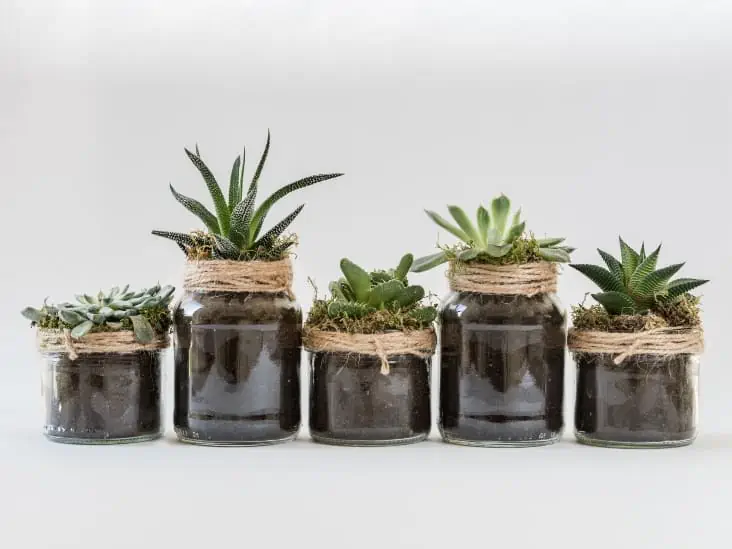
Succulents in a jar.
It is also good to consider the height of your succulents while planting them together.

You also need to find some trailing or cascading succulents to serve as spillers to make your succulent arrangement complete.

Some of the tall-growing succulents you can use as thrillers include Sansevieria and Aeonium. Short growing succulents that serve as great fillers include Sempervivum, and Echeveria while some examples of cascading/trailing varieties include String of Pearls, String of Hearts, Sedum, and Senecio.

Keep in mind that these are only a few examples, but there are numerous options for each category that you cannot exhaust. Feel free to apply your own ideas and go with something that looks good to your eyes.

3. Color

Generally, choosing a good theme for your succulent home arrangement is relatively easy. Whether you want it to be monochromatic or colorful, there are many different kinds of succulents that can make your combination look great.

There are three main ways to combine colors in your succulent arrangement; analogous, monochromatic, and complementary.

For a monochromatic arrangement, you need to combine succulents with the same colors but with different shades. For instance, the typical green succulents come in various hues. Therefore, you can easily make more textured succulent arrangements using different shades of the same color.
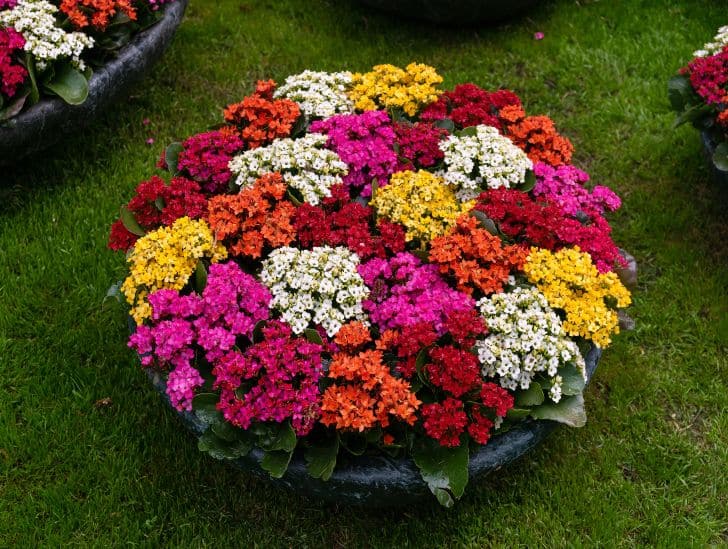
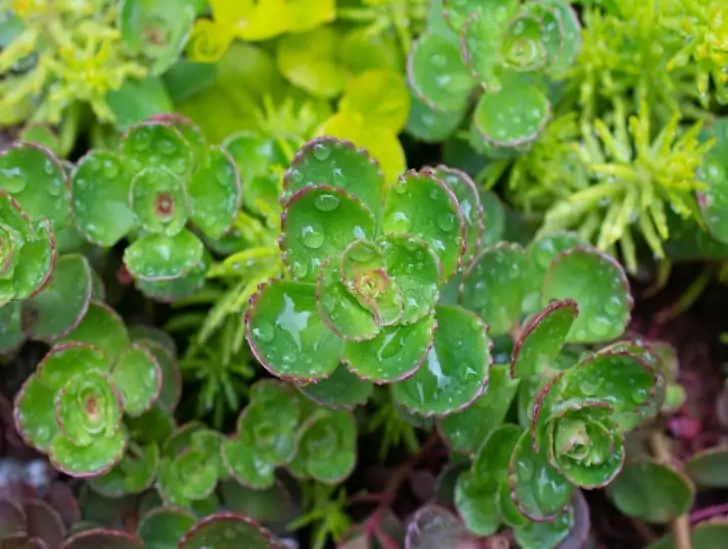
Different colors of kalanchoe.
You want it to be monochromatic or colorful?

In an analogous arrangement, your primary goal is to combine succulents with colors sitting next to each other in the primary color wheel. For instance, yellow, yellow-green, and green are excellent analogous arrangements that provide you with different options when picking succulents.

A complementary arrangement calls for the use of colors found on opposite sides of the color wheel. For instance, you can use green and red in your arrangement.

4. Shape and Texture

You can easily achieve an interesting succulent arrangement by using various plants with different shapes, textures, heights and other special features such as hairs.

You can always choose among the relatively tall and upward growing succulents such as Aeonium or Sansevieria or go with rosette-forming succulents such as Echeveria and Sempervivum.

Your options are truly endless when it comes to choosing succulent shapes and textures. As long as the plants you choose have similar care requirements, you are good to go.

You can also play with succulents with varying heights to achieve something more interesting. Some gardeners prefer to create a relatively uniform design using succulents of the same height but different colors and textures.
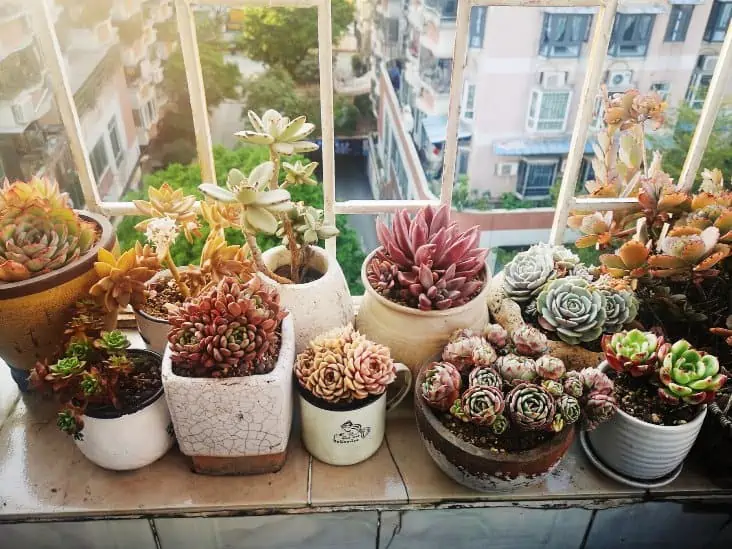
Different kinds of succulents.
Your options are truly endless when it comes to choosing succulent shapes and textures.

Some succulents such as Aloe Vera, Haworthia, and Gasteria usually provide a fantastic texture with their unique white markings. Any type of cacti will also add wonderful texture to your arrangement with their spines and unique stems.

Although most succulents are popular for their unique stems and chubby leaves, some of them produce stunning flowers during the flowering season.

So, if you include a flowering succulent in your arrangement, you can be sure of enjoying a beautiful floral display during the blooming season.

5. Pots and Containers

Pots and containers also play a critical role in determining which succulents can grow together in a succulent arrangement. Choosing the right container and experimenting with its shape, scale, texture, and even color can be as fun as arranging your succulents.

Terrariums
Go for one with color, texture, and shape that will either complement your succulents.

When choosing a growing pot to use in your succulent arrangement, go for one with color, texture, and shape that will either complement your succulents or offer a fascinating contrast. Don’t choose a growing pot just for the sake of it.

Gardening experts with plenty of experience in succulent arrangement say that choosing a pot carefully can make a significant difference since there are different forms of top dressing, such as broken blocks or pebbles, that will only look good in specific types of containers.

Can You Combine Succulents with Other Plants?

The simple answer is “yes.” Although we have been talking about succulent arrangements exclusively, it doesn’t mean that you cannot combine succulents with other types of plants to achieve a truly mesmerizing arrangement.

Combining succulents with herbs usually works best because most herbs are used to survive in the kitchen. It means they have developed some level of drought resistance and love bright light. Furthermore, they usually don’t require a lot of care and maintenance to thrive.

It means that herbs resemble most succulents in their growth and general care needs. Additionally, herbs tend to add a range of colors and textures to your succulent arrangement. They even have unique fragrances that give a new dimension to your succulent garden.

Some of the herbs that can be grown together with succulents include Oregano, Curry, Savory, Thyme, Rosemary, Marjoram, Sage, and Lavender.

The most important thing you need to pay close attention to when growing herbs and succulents together is how you water your plants. This is because most herbs are used to growing in-ground and are usually provided with slightly more moisture than succulents.

Therefore, if you combine herbs and succulents in your succulent arrangement, you need to give your herbs slightly more water than succulents. You can still use regular succulent soil in your container but find a way of watering the herbs slightly more than your succulents.

Final Thoughts

Combining several succulents in one pot helps to accentuate their beauty. You can even pair succulents with non-succulents and play around with your design to see what you can achieve.

However, if you decide to pair succulents and non-succulents, ensure the potting mix you use is specially formulated for succulent plants.

The truth is that there is no limit to your succulent arrangement possibilities, and everything is 100% possible. So, don’t be afraid to take your chances and experiment until you find something that works perfectly for you!

5 Golden Rules For Watering Hens And Chicks Plant

Sempervivum, or hens and chicks, is a unique and hardy succulent. Hens and chicks plants, by their nature, require less water than most common plants. This plant has fleshy leaf rosettes that tend to hold water. As a result, this low-maintenance plant may grow with significantly less water than other indoor or outdoor plants.

While hens and chicks can survive for long without water, they will not flourish in a prolonged dry environment. Again, keep in mind that it may not stay for long without water when it is still young. 

Read on as we delve into the golden tips to water your hens and chick succulent.

1. Watering Depends on the Type of Soil

Hens and chicks thrive in rocky, sandy soil, making them perfect for rock gardens. They will also do well in flower beds with fast well-draining soil when planted outdoors.

A Sempervivum on a rocky garden.
Hens and chicks thrive in rocky, sandy soil, making them perfect for rock gardens.

Here is how you can prepare a well-draining potting mix at home:

Step 1: Mix one portion of coarse sand with two potions of potting mix containing coconut coir, fir bark, or peat moss. The potting mix adds nutrients to the soil.

Step 2: Add an equal amount of perlite, pumice, or sand to the mixture. This portion will help in water drainage.

Step 3: Combine all the portions in a 1:1 ratio, and you can add a little bit of succulent fertilizer for additional soil nutrients. When mixing, ensure the soil does not form into balls but spreads well.

The type of soil it is growing on will determine your watering schedule. If Sempervivum grows in clay soil, you can water it at least once a month in the summer.  Clay soil takes a long time to dry up; first, the top layer dries while a crust forms preventing the lower layer from losing water.

In this type of soil, hens and chicks do not require watering at any time of year other than the summer months.

On the other hand, sandy soil drains water quickly, even when heavily watered if there is no rain, water hens, and chicks two times a week during summer.

In the second half of fall and throughout the winter, Sempervivum in sandy soil may not require watering; they will have enough moisture from rainfall. You can only water them when there is no precipitation at least once in two weeks.

2. Watering Hens and Chicks in Different Seasons

In the summer, water hens and chicks more often. During this period, the sun dries the soil quite fast. Therefore, you may have to water it two times a week when there is no precipitation or once a week with rainfall.

If the topsoil does not dry in one day, no additional watering is required. The succulent leaves and stem are sufficiently fleshy, holding much water in them, and this makes the plant able to endure the heat without water for 2-3 days. Furthermore, there is enough moisture content deep in the soil for the roots.

Sempervivum in a pink pot.
Constantly be checking on the ground moisture by digging your finger one inch into the ground to determine the ground dumbness.

If you water the plant more often, it will die from root rots. You only need to moisten the soil around the plant to grow.

Watering during autumn is almost not necessary. During this period, the plant tends to enter dormancy in preparation for winter. Furthermore, at this time of the year, the autumn rains start. But it doesn’t mean it doesn’t need water; at this time, water it once per week.

An only exception is at the start of autumn when there is still strong sunshine drying up the soil, in which case you have to water your Sempervivum.

During winter, hens and chicks do not require watering. At this time, they enter dormancy and may experience little to no growth at all. Moreover, winter sunshine isn’t strong enough to dry the soil. All this makes watering not necessary.

Watering during winter is more likely to end in the plant rotting.

Pro Tip: If planted in different climate regions where the soil dries up during winter, making the plant lack water ultimately, you may need to water it at least once every two weeks.

During spring, hens and chicks thrive; this time, the plant needs a proper watering schedule. Ensure to keep the soil moist enough for it to grow. You will need to water it once a week. If the plant has lots of rosettes, it’ll need more water.

Constantly be checking on the ground moisture by digging your finger one inch into the ground to determine the ground dumbness. If the soil is dry, water it.

However, when there is less rain with strong sunshine nearing the end of spring, which doesn’t happen often, you’ll have to water your plant.

Here is a table summary of watering your plant in different seasons.

SeasonClay SoilCactus Mix/Succulent Soil
SpringOnce a week
WinterOnce in four weeksOnce a week
AutumnOnce a weekOnce a week
SummerOnce a weekTwo times a week

3. Consider the Hens and Chicks Plant Size

Another golden rule to look at when watering your plant is its size. An adult Sempervivum will have a different watering schedule to a young hens and chicks plant.

Water newly transplanted plants every two days to help them thrive. However, immediately they are of age, reduce watering and proceed as you would for an adult Sempervivum.

Watered Simpervivum.
An adult Sempervivum will have a different watering schedule to a young hens and chicks plant.

The best you can do during propagation is to have the soil moist. Remember not to make it soggy, or the stem or leaf cuttings will rot.

On the other hand, grown Sempervivum has less surface area to volume ratio; hence, it experiences a low evaporation rate. However, the plant will still need watering but water them less often as they retain more moisture better than young plants. So water them at least once a week and during drought, at most two times a week.

4. Have a Look at the Type of Container You Use for Planting 

Hens and chicks are shallow-rooted plants, and this means you can grow them in miniature or shallow pots. While hens and chicks will look good in almost every pot: clay, plastic, or glass pots. Not every pot will let your plant thrive well when watering.

The size of the container also plays a role in how often you need to water it. A small container or shallow pot lets the soil dry pretty fast; therefore, you may need to water hens and chicks more often in such containers.

Sempervivum in a pot.
You can grow them in miniature or shallow pots.

In contrast, a larger container helps retain much soil moisture; hence might need watering less often.

When it comes to the container material, a clay pot works best. Clay pots help absorb moisture from the soil. In addition to having drainage holes, they let the soil lose water slowly and help prevent root rot.

Pots made from clay are terracotta and ceramic pots. Other pots other than clay are made of wood, plastic, metals, or fiberglass. Before using them, ensure they have drainage holes to prevent water from sitting at the bottom when watering.

5. Location of Your Plant

Whether growing outdoors or indoors, the watering schedule is bound to be different.

How to Water Hens and Chicks Outdoors

Watering outdoors Sempervivum depends on the seasons and type of soil. During the growing season, water once a week, and during winter, only water if the soil is dry. You can check the soil moisture content by digging an inch into the soil using your fingers, or you can purchase a moisture meter.

The right time to water your plant is early morning or late evening. Early morning watering helps the plant have enough moisture to help it survive the noon heat. 

Keep in mind to always water only when the soil is dry.

How to Water Hens and Chicks Indoors

Water your indoors hens and chicks until water sips through from the pot’s drainage holes during the growing periods. Water draining is also beneficial in removing excess plant fertilizer from saturating the soil at the bottom. Once the soil dries up, add more water.

It is best to leave your plant unwatered during dormancy, or you may water it once a month. The best you can do is prune dead leaves or lower leaves that look soft and squishy.

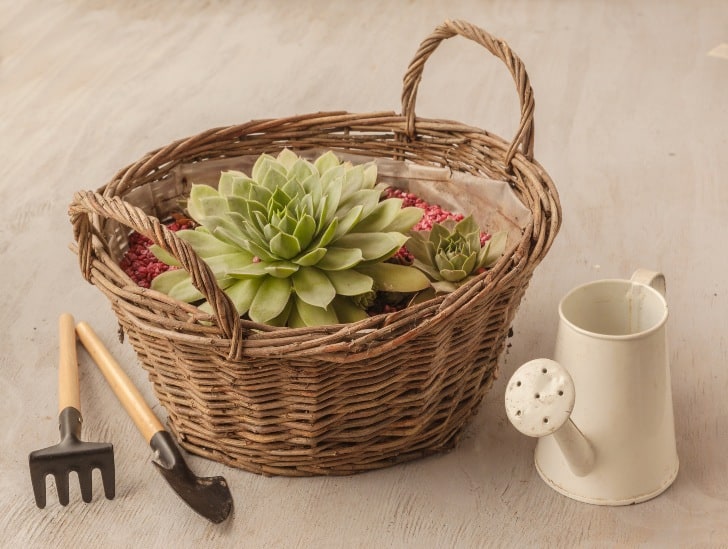
Sumpervivum on a basket with tools.
You can be watering the plant at least once the soil is dry.

In the winter, when you may use a heater to warm up your home, the heater will dry up the air, and your plant will drain the little available moisture in the soil fast enough. You can be watering the plant at least once the soil is dry. Another thing, place a tray with water next to the plant to humidify the surrounding air.

Final Thoughts

Suppose you are a gardening beginner or an expert looking for a plant that is easy to care for, then we recommend hens and chicks. This plant can go for long without water, and when it needs water, you will be able to tell from its signs.

We hope with these golden rules, you now know when and how often to water your hens and chicks plant in different seasons. 

8 Amazing Facts You Didn’t Know about Haworthia

Haworthia, also known as the zebra cactus, is one of the most amazing houseplants. This succulent is a great addition to sunny indoors and relatively bright window sills. You can also use it as a desk plant since it can survive in artificial medium light and only need to be watered once or twice a month. In fact, overwatering is one of the leading causes of death for this plant.

This article highlights some of the amazing facts about Haworthia that you need to know. Read on to find out everything you need to know about this amazing plant.

So, what are some of the amazing facts about Haworthia? The succulent is native to South Africa and can survive in drought conditions relatively long. It comes in a wide range of varieties, but the two common types of Haworthia are Haworthia Attenuata and Haworthia fasciata. The plant is closely related to aloe vera and can grow up to 15 centimeters tall when provided with the right conditions. Its rosette of leaves is usually approximately 20 centimeters wide. Haworthia flowers during summer, and its flowers are mainly white. The flowers can stay alive for a relatively long period if the growing conditions are right.

1. Origin

The Haworthia plant is native to the eastern parts of South Africa, where they thrive in relatively dry climatic conditions. The plant is often mistaken for aloe vera because of its similar shape.

Haworthia plant outdoor.
Haworthia thrive in relatively dry climatic conditions.

Haworthias are mostly found in relatively sunny or partial shade conditions where they may go without water for several months. This succulent is generally a hardy plant that requires minimal care to survive in any environment.

2. Scientific Classification

The scientific name for this succulent is Haworthia Fasciata, and it is from the Asphodeloideae family of plants. Haworthia is its Genus name.

The Genus Haworthia is named in honor of Adrian Hardy Haworth, a renowned botanist and entomologist.

With over 80 species of different plants under its belt, Genus Haworthia is classified as one of the biggest Genus that offers botanists and gardeners a wide range of succulents to study and explore.

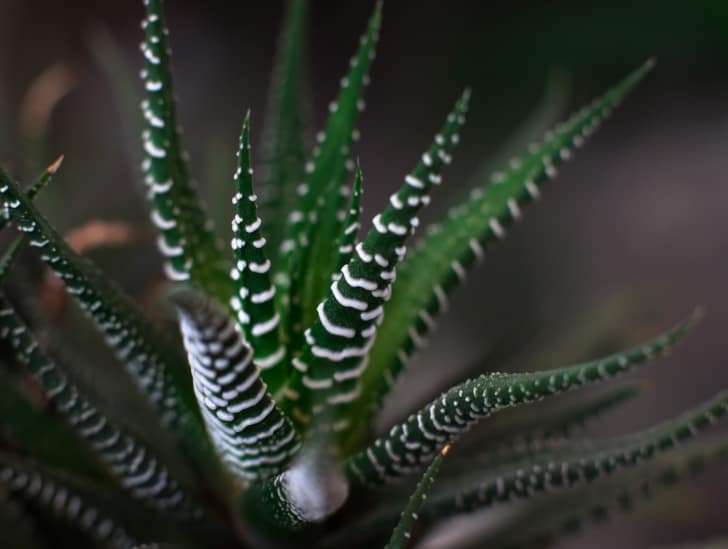
Haworthia Fasciata plant in a pot.
Some of its other names include the Zebra plant and the Zebra Haworthia.

For instance, Haworthia Fasciata is commonly referred to as the Zebra cactus, even though it is not a cactus but a succulent. Some of its other names include the Zebra plant and the Zebra Haworthia.

The name “Zebra” is given to the succulent because it features white stripes on its surface, making it look like a zebra. Two other plants that are not succulents but are also referred to as zebra plants are Calathea Zebrine and Aphelandra squarrosa.

However, nothing comes close to the beauty exuded by the Zebra Haworthia, which has made it the most prominent among the Zebra plants mentioned here.

We have already mentioned that the most common Haworthia species is the Haworthia Fasciata which resembles a zebra hence the name zebra plant.

However, Haworthia attenuata is closely related to Haworthia Fasciata, and the only difference between the two plants is the tubercles on the leaves.

Haworthia attenuata has both sides of its leaf surface covered by white tubercles, while Haworthia Fasciata’s inner leaf surface is smooth and devoid of any white marks. Something else you need to note is that Haworthia fasciata is a rare species.

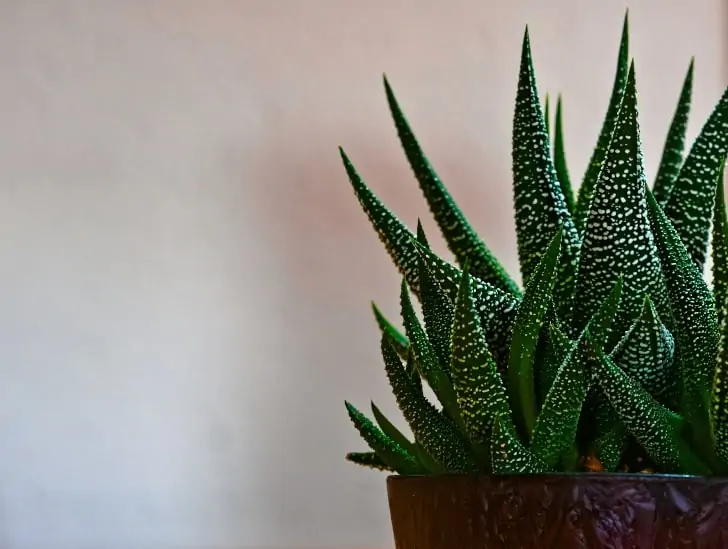
Closeup image of Haworthia Attenuata.
The only difference between Haworthia attenuata and Haworthia Fasciata is the tubercles on the leaves.

Many succulent beginners tend to think that the zebra plant is a stripped version of aloe vera. That is not true, even though the two plants are related.

Both are from the same sub-family and share a common origin, but there are clear mark differences that distinguish these two plants.

4. Notable Features

Haworthias are succulents adapted to surviving in relatively dry climatic conditions. They store plenty of water in their stems, allowing them to survive for relatively long periods without water.

These plants grow slowly and won’t invade your desk space at all. The white spots on their leaves are known as “pearls” and are responsible for their zebra-like appearance.

As these succulents grow, they usually form pups/ new offshoots, which can easily be separated from the main plant and propagated into new plants.

Unlike most of the other succulents that grow during spring/ summer and go into winter dormancy during winter, the Haworthias grow during winter and are semi-dormant during the summer season.

5. Haworthias Can Thrive Both Indoors and Outdoors

Haworthia is a highly flexible plant that gives you the freedom to grow it indoors or outdoors. You can cultivate them in your garden, greenhouse or conservatory. They are relatively easy to care for and thrive inside containers and planters in your office or home.

You must keep in mind that these succulents are desert plants and are adapted to a specific kind of climate. They are not cold-hardy plants and won’t survive in freezing temperatures.

Therefore, whether you are growing them indoors or outdoors, you need to provide them with relatively warm and stable temperatures for them to survive.

Haworthia plant with offset.
It is a highly flexible plant that gives you the freedom to grow it indoors or outdoors.

If you live in an area that experiences cold winters, consider covering your outdoor Haworthia during the cold season or move it indoors.

Room temperature provides the best conditions for these succulents to survive and thrive. It is advised to keep them at anything between 50oF and 65oF.

The plant is slow-growing and will take a couple of years to reach a height of 13-15 centimeters. Its rosette leaves are approximately 20 centimeters wide.

Although the stem of the Haworthia isn’t so large and tall, its roots grow deep into the ground pretty quickly. If you have the plant in a pot and the roots grow larger than expected, you should consider re-potting it to a relatively larger pot.

6. Every Haworthia Grown at Home Deserves a Name

So, are you fascinated about Haworthias and want to bring at least one to your home? If so, you need to do more than just ordering it from your nearest plant nursery, planting it in a pot and positioning it somewhere in your indoors.

Besides taking care of your Haworthia, you also need to give it a name as soon as it is delivered to your home. In fact, giving your plant a name will make it easy for you to remember to care for it since it will be part of your family.

So, think of a nice name to give to your plant. Something like “Peter the Haworthia” sounds great but feel free to choose whatever name you like.

A Howorthia plant recieving a sunlight.
Exposure to full sunlight provides essential chemicals needed to help the plant produce flowers.

Once you have given your Haworthia a name, find a good spot that receives plenty of bright light and position it there. If your house doesn’t receive plenty of natural light, consider using artificial fluorescent lights to provide your plant with the much-needed light.

Set a watering reminder and only feed your plant during the active growing season. If you notice that it is struggling to adjust to its new environment, find out what you are doing wrong and correct it immediately.

7. Only Re-pot When the Cluster Is Too Large for Current Container

Haworthias grow pretty slowly, and most species stay fairly small for a couple of years. Mature Haworthias will range between three and five inches tall.

It is advisable to grow a new Haworthia plant in a relatively shallow, wide dish where the mother plant can easily grow offshoots to make a large colony of plants with more leaf clusters.

Once your cluster is too large for the container, you should consider re-potting the plant into a bigger container. Re-potting should be done during spring or early summer so that the plant can spend summer bedding into its new home and growing new leaves.

The best option is a wide, shallow growing container filled with fresh succulent soil. If you are interested in propagating your Haworthia, this is the right time to take a few offsets from the mother plant and grow them into new plants. 

Ensure you use a sharp knife or pair of fine clippers when taking the offset from the mother plant to keep as many roots as possible. Allow the offset to dry a little bit, then transfer it into a relatively small pot using the same succulent soil that the mother plant is growing in.

8. Haworthias Are Not Monocarpic Plants

Haworthias usually don’t perish after flowering since they are not monocarpic plants. If you want to make these succulents flower, ensure they are getting optimal growth conditions and are grown in the right type of potting mix.

If you are growing them indoors, bring them outdoors and expose them to full sunlight for a couple of hours in the morning to stimulate flowering Exposure to full sunlight provides essential chemicals needed to help the plant produce flowers.

These succulents usually flower during summer, and their flowers can survive for a relatively long time as long as the conditions are right.

Summary

That is it about Haworthias, and we hope you are now looking forward to adding this succulent to your plant collection if you don’t have it yet. These plants are easy to care for and very rewarding to succulent enthusiasts.

Furthermore, there are many different types of Haworthias you can choose from and start your journey even if you have no experience growing and looking after succulents.